
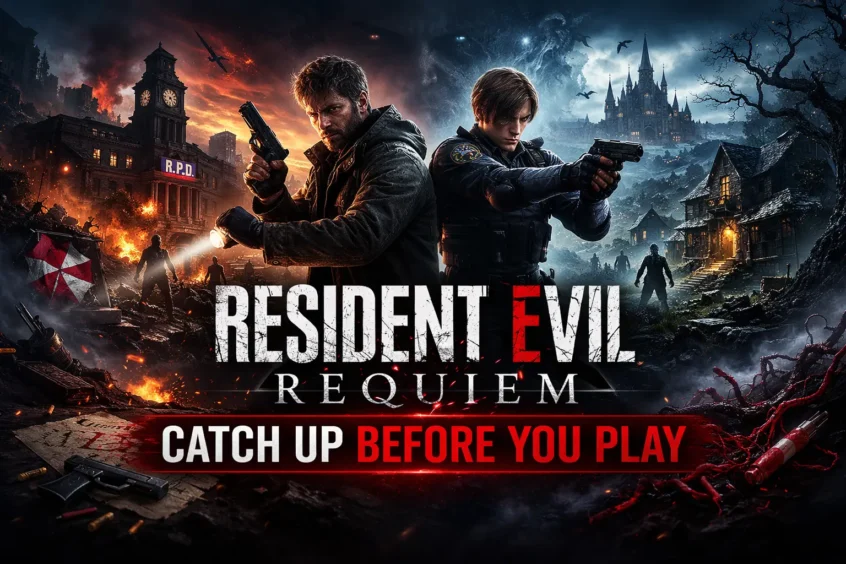
Resident Evil Requiem launches tomorrow, and whether you’ve been surviving outbreaks since the ’90s or you’re stepping into the series for the first time, one question matters most: what exactly has happened in this world so far?
Across nearly three decades, Resident Evil has shifted from claustrophobic survival horror to globe‑spanning bio‑terror action and back again. Cities have fallen. Corporations have crumbled. Heroes have evolved — and sometimes crossed lines they never expected to.
If you haven’t played every entry, here’s a complete, streamlined catch‑up on the events, characters, and turning points that shaped the world leading into Requiem.
Resident Evil Requiem Trailer
The Mansion Incident — Where It All Began
The series opens in 1998 with the infamous Spencer Mansion incident. S.T.A.R.S., an elite police unit, is sent to investigate grisly murders in the Arklay Mountains near Raccoon City.
Inside the mansion, they uncover Umbrella Corporation’s illegal bio‑weapon experiments. The T‑Virus — designed as a military asset — has infected staff and test subjects, creating zombies and grotesque mutations.
This is where we meet Jill Valentine, Chris Redfield, and Albert Wesker. Wesker’s betrayal becomes the first major twist: he’s been working for Umbrella all along, using his own team as data collection.
The mansion is destroyed, but the virus escapes with it.
The Fall of Raccoon City
The outbreak spreads into Raccoon City in Resident Evil 2 and Resident Evil 3, transforming a corporate cover‑up into a full‑scale urban collapse.
- Resident Evil 2 follows rookie cop Leon S. Kennedy and college student Claire Redfield as they navigate the infected city.
- Resident Evil 3 follows Jill Valentine, relentlessly hunted by Nemesis, a bioweapon programmed to eliminate S.T.A.R.S. members.
As the infection becomes uncontrollable, the U.S. government orders a nuclear strike, wiping Raccoon City off the map.
Umbrella’s crimes are eventually exposed, and the company collapses — but its research lives on in the black market.
Bio‑Terror Goes Global
With Umbrella gone, bio‑weapons become tools of international terrorism.
- Resident Evil 4 shifts the series dramatically. Leon, now a government agent, is sent to Spain to rescue the President’s daughter. Instead of the T‑Virus, he encounters Las Plagas, a parasite capable of controlling its hosts. The over‑the‑shoulder camera and action‑heavy combat redefine the franchise.
- Resident Evil 5 reunites us with Chris Redfield as he confronts Wesker in Africa, bringing their long‑running conflict to a dramatic end.
- Resident Evil 6 expands the scale even further, with multiple campaigns covering global outbreaks and escalating bio‑terror threats.
By this era, the series has moved from isolated horror to worldwide crisis. Viruses aren’t accidents anymore — they’re weapons.
Back to Horror — The Winters Saga
After criticism that the series had become too action‑focused, Resident Evil 7: Biohazard resets the tone.
We meet Ethan Winters, an ordinary man searching for his missing wife in a decaying Louisiana plantation. The game shifts to first‑person, returning to tight spaces, resource scarcity, and psychological dread.
The threat this time is the Mold, a new bioweapon responsible for the terrifying Baker family.
Resident Evil Village continues Ethan’s story in a remote European settlement filled with gothic horror. Chris Redfield returns in a morally complex role, and the origins of the Mold are explored in depth.
Without spoiling major twists, Village closes a major chapter and sets the stage for the franchise’s future.
The Remake Era
Capcom revitalised the classics with modern remakes of Resident Evil 2, 3, and 4. These versions:
- modernise gameplay and visuals,
- tighten continuity,
- and introduce iconic moments to a new generation.
They’ve become essential entries in their own right.
So Where Does Resident Evil Requiem Fit?
That’s the big mystery ahead of launch.
Will Requiem continue the aftermath of Village? Will it return to legacy heroes like Jill, Leon, or Claire? Or is Capcom preparing a brand‑new arc?
What’s clear is that the Resident Evil universe has evolved from a single corporate experiment into a world permanently shaped by bio‑weapons. Governments, cults, private militaries, and rogue scientists have all tried to harness infection for power.
Recent entries suggest Capcom is committed to horror‑first storytelling again — but this series has never been afraid to reinvent itself.
What New Players Really Need to Know
If you’re jumping into Requiem fresh, these are the essentials:
- Umbrella created the original T‑Virus.
- Raccoon City was destroyed to contain the outbreak.
- Bio‑weapons spread globally after Umbrella’s fall.
- Modern entries focus on new strains like the Mold.
- The series blends returning heroes with new protagonists.
You don’t need encyclopaedic knowledge to enjoy Requiem, but knowing the history makes every reveal hit harder.
Final Thoughts Before Launch
Resident Evil has survived console generations, genre shifts, and complete reinventions. Few horror franchises have adapted so often while keeping their identity intact.
Whether Requiem continues the Winters storyline, revives a classic hero, or begins something entirely new, it enters a universe with decades of scars — and endless potential for new nightmares.
If you’re diving in tomorrow, you’re now fully caught up.



You must be logged in to post a comment.