
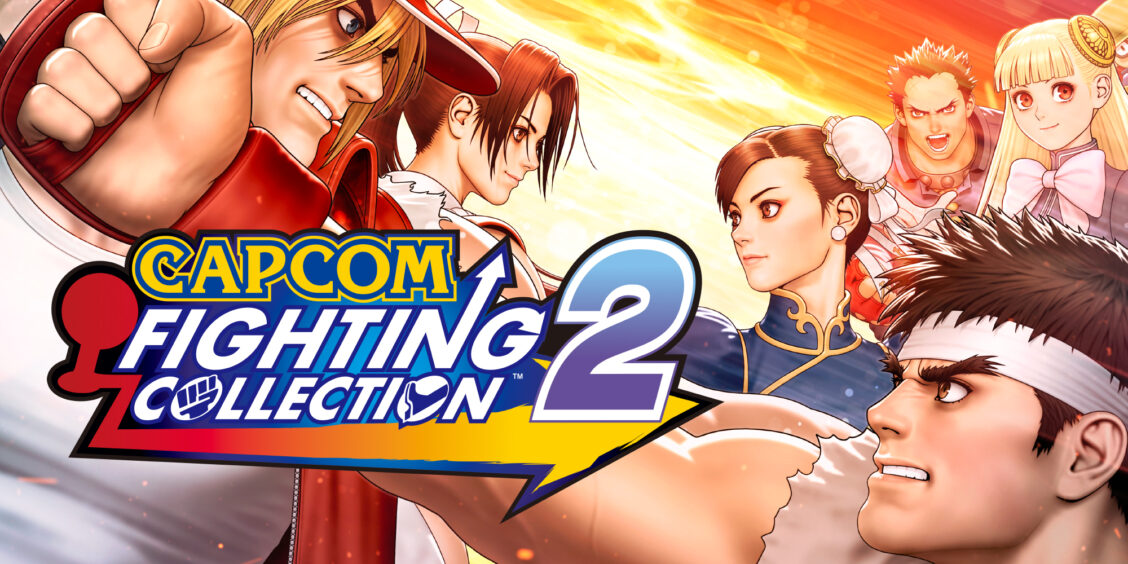
Hot on the heels of their previous retro fighting compilations, Capcom Fighting Collection and the superb Marvel Vs. Capcom Fighting Collection: Arcade Classics, comes another dive into Capcom’s humongous catalogue of games with the direct follow up to Capcom Fighting Collection with the appropriately titled Capcom Fighting Collection 2!
Phew! With those titles out of the way, we can take a look at what Capcom are giving us this time around from their vault of gaming goodness. Eight games make up this collection, spanning the years 1998 to 2004 and giving us a variety of fighting game styles to suite your needs. Are you looking for madcap multiplayer shenanigans? Old-school, hard-core technical 2D fighting? Or do you just want something splashy from the early days of 3D fighters? Whatever your jam, Capcom’s brought the bread to smear it on.

Your tour through this era begins with Plasma Sword: Nightmare of Bilstein, followed up by Powerstone, Powerstone 2, Capcom Vs. SNK: Millennium Fight 2000 Pro, Project Justice, Street Fighter Alpha 3 Upper, Capcom Vs. SNK 2: Mark of The Millennium 2001 and, finally, Capcom Fighting Evolution.
Capcom Vs. SNK 1 and 2, Street Fighter Alpha 3 Upper and Capcom Fighting Evolution are the classic Capcom 2D fighters, full of gorgeous sprite animation, a variety of moves and a whole bunch of technical confusion for those not in the know. Sure you can jump in and have fun, but Capcom’s 2D fighters are renowned for their in-depth combat systems that require a fair amount of work to be put in if you want to get good at them, even just to beat the AI at higher difficulty levels.
That said, all four games are still fun to play even for casual players with the Capcom Vs. SNK games and Street Fighter Alpha 3 Upper featuring stacked rosters and enough -isms to confuse anyone! Capcom Fighting Evolution has a smaller, more eclectic roster to choose from but isn’t any less fun to play.

Plasma Sword: Nightmare of Bilstein and Project Justice are a time dive back into the early days of 3D fighters, reminding me of playing the first Soul Calibur and Tekken games respectively. Of all the traditional fighters here, Plasma Sword is the only one of the bunch that doesn’t feature tag-team or team-based combat.
Project Justice is the sequel to Rival Schools, featuring a story straight out of a school fighting anime and reminded me a lot of Tekken Tag Tournament. I do find both of these titles a strange addition to a compilation right now as both are sequels to games that haven’t appeared in the previous collections.
Finally we have the games that would get me to go out of my way for this collection: the Powerstone games. The major difference between Powerstone 1 and 2 is that Powerstone 1 is a two player competitive affair while Powerstone 2 ups the madcap mayhem to four players. These isometric 3D brawlers are pure arcade fun, full of weapons and power-ups dropping in the matches to beat your opponent to snivelling bits with.
There’s a great amount of environment interaction, such as spinning on poles to attack opponents though Powerstone 2 takes that to the next level with boss fights, multi-stage arenas full of traps and weapons and three AI controlled combatants if you can’t manage to get three friends over – or online – to beat it. These game were addictive when I first played them on the Dreamcast, and are just as addictive and chaotic now.

As with the previous compilations, these games feature a robust set of quality of life features and rollback netcode. You can choose to play the games in online of offline modes in either arcade, versus or training modes. Training mode gives you a nice view of the characters hit-boxes in the 2D games. You can view each games Marquee Card which is, for those who might not know, the games instructions that were usually printed on the side of the arcade cabinets. This, along with the toggle-able boot screens for each game is a really great touch.
You can swop between the English and Japanese versions of the games, choose what wallpaper you want in the background, change the games resolutions, enable filters and change the games internal resolutions, which isn’t to be confused with the overall resolution. Basically, it functions as a way to sharpen the image. You can also change the games difficulty settings and slowly work your way up to the heights of a master. Finally there’s a gallery section to view each of the games production artwork and a music player to listen to the games soundtracks.
There are two niggles to this collection though. For one, Capcom Fighting Evolution, bizarrely, has some rather low resolution and fuzzy looking backgrounds. The character animation is still gorgeous but these backdrops standout like a sore thumb in a series of fighting games characterised by their gorgeous artwork and personality filled backgrounds.

Capcom Vs. SNK: Millennium Fight 2000 Pro has a more serious, random visual bug that sees the character cards during play go on the fritz, creating a visual mess of animation states that can be very distracting. I’ve had it happen during multiple runs through arcade mode so it’s definitely something that the developers have to take a look at.
While some titles here may not be as loved as others in Capcom’s oeuvre, this is still a great collection containing two of my favourite arcade and Dreamcast games. The best part is that there’s a fix here for just about every type of fighting mood you may be in from hard technical fights to zany competitive four player shenanigans. And if you’ve already bought into Capcom’s two previous compilations, then you definitely need to add this to the collection.
Capcom Fighting Collection 2 Trailer
Read more awesome reviews >>here<<.
The code was provided by the distributor.



You must be logged in to post a comment.