
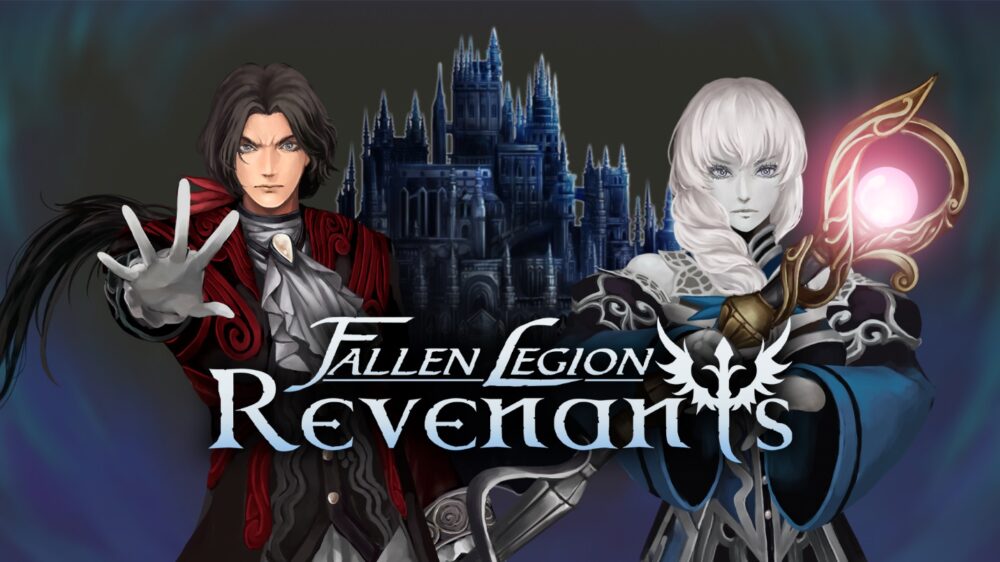
If there’s anything that caught my attention when I first heard about Fallen Legion Revenants is its mix of tile-based strategy along with the 2D art style akin to the likes of Vanillaware’s Grand Knights History or its spiritual successor the Grand Kingdom from the devs in Monochrome Corporation. Now if that sentence alone didn’t get you excited then let me tell you more about it.
Fallen Legion Revenants which I’m going to address as Revenants for simplicity’s sake takes place in a dystopian world where the last survivors of humanity are housed in Welkin Castle a structure floating in the sky and far from the surface filled with the horrific miasma and plagued creatures that lurk the realm. Our protagonist, Rowena whom is a revenant, is someone who seeks to be revived and be together with his own son. Meanwhile, you also get Lucien, the other half of the game’s central protagonist which unlike Rowena’s portion of strategic and timing-based combat, Lucien on the other hand becomes the Danganronpa or Ace Attorney of the game’s secondary gameplay element. Basically, he’s a council member that resides in the castle and gathers information on where Rowena and her party of exemplars go aside from basically doing what council members do… talk.

This mix of elaborate decision making through conversations and information gathering along with the tile-based strategical combat provides a solid foundation on paper. But let’s be honest, whenever you hear the word “on paper” usually means someone’s about to say in practice it doesn’t pan out that well… which if you did think that, then you’re basically right. Despite the great context of the game from its overall world setting to the kind of appeal, it brings to the table, much of the game becomes a stale and awkward battle of attrition when most adventures pan out pretty much the same.
Your group of warriors automatically move from one side of the screen to the other and eventually meets monsters you are forced to fight before you can advance. But unlike a traditional turn-based RPG, the game follows an active battle system where can attack for as many as you can as long as you have enough meter to expend. Each character is also controlled with the face buttons instead of a menu you can navigate to initiate attacks or skills. While this on its own isn’t a huge deal-breaker, it becomes awkwardly confusing at times when it’s time to learn everything else such as perfecting your blocks at the right time to ricochet projectiles or stagger melee attackers.

However, that’s easier said than done no thanks to the many things you’ll also need to learn such as learning when to attack as characters will be actively moving on the screen when they take any action which can easily mess up your blocks and deflect timing. It also becomes really confusing once you start using each character’s skills which can be done by holding either the right trigger or shoulder button along with a face button that corresponds to the character you want to use. This is further made more confusing when you can move one tile forward or backwards to evade attacks or debuff tiles aside from forcing your enemies to move or switch tiles to your advantage. Also, you can even switch which exemplar takes the frontline which is great to avoid further HP damage from tanking hits that adds to the overall strategy. So again, while on paper it sounds like a promising aspect of strategy, in practice it becomes confusing because of the game’s overly cramped mechanics that didn’t really play as fluid due to its pacing. There’s a sharp learning curve that needs to be learned pretty early on which can either make or break your overall experience.
Now with that out of the way, what you have can either be a game you’ll be enjoying for its heavy take on quick reflexes and decision making or something you’ll be trying out for yourself if you just think I’m crazy but may very well drop later down the line. But sadly if the style of combat and its mechanics doesn’t really interest you in any way then I think you’ll find it even more disappointing that the narrative’s overall slow pace drags it down a bit more as the game forces you into more long-fought battles to mitigate its lacklustre and slow story progression.
Visuals are something that becomes more of its saving grace, not that it really makes a whole lot of difference but its pleasing aesthetics mixed with the grotesque creatures makes for an interesting distraction when everything else has already fallen through for me. Each character’s unique style and take on armour is charming which is really the only reason to make me push farther into the game other than my sense of commitment to finish a game I’m reviewing. They also have their own set of skills and playstyle but who really cares at this point, not this guy.
In a nutshell, Revenants is simply put, a hard sell for me for its steep learning curve to its combat. I’m not saying it’s a bad system however it does limit its audience to do those who can try to learn its mechanics before they end up moving on to the next game. Its narrative and the grand scheme of things are too slow-paced that I couldn’t pretty much enjoy what it has to offer. There’s definite potential here however it’s something I couldn’t grasp for being casual.
Fallen Legion Revenants is available now for PS4 and Nintendo Switch
This review is based on the PS4 version of the game that can be purchased here for £34.99
Enjoy the review? want to read more of our reviews? then click right here to be whisked away to the realm of our opinions.



You must be logged in to post a comment.