

Lost in Random The Eternal Die, developed by Stormteller Games and published by Thunderful Publishing, marks a bold genre shift from the 2021 action‑adventure original. This is where gothic fairy‑tale charm meets rolling dice, tactical deck‑building, and fast-paced roguelike runs.
The Setting & Story: Queen on a Quest
You play as Queen Aleksandra, once the shadowy ruler of Random, now trapped within the Black Die—a cursed artifact born of fate and regret. To atone and reclaim control, she must fight through the shifting rooms of the Black Die, confront Mare the Knight, and attempt redemption… one strategic run at a time.
The narrative is emotionally grounded and surprisingly mature—exploring control, loss, and the randomness of life. It doesn’t pull punches, but sometimes leans into metaphor a bit too heavily.

Character & Lore Depth
Aleksandra isn’t just a protagonist—she’s a former antagonist seeking redemption. Each biome reflects a chapter of her past, with enemies and bosses drawn from her own history of cruelty and control. These encounters aren’t just battles—they’re reckonings. The game cleverly uses environmental storytelling and NPC dialogue to reveal her regrets, making each run feel like a step toward emotional closure.
Combat & Gameplay: Strategy with a Side of Mayhem
Lost in Random The Eternal Die merges real-time action with turn-based tactical choices. You can’t unleash special attacks until you collect crystals and roll Fortune. Card attacks and relics bring variety and build depth to each run.
- Weapon mix: sword, hammer, bow, lance—each with charge and upgrade paths.
- Fortune: your sentient die—throw him for ranged damage and retrieve him manually.
- Relics: over 100 to mix and match, affecting everything from builds to die interactions.
- Cards: 15 abilities ranging from poison daggers to freezing vortexes.
The pace is sharper than the original, with roguelike loops inspired by Hades. While some runs feel underpowered if luck is bad, pulling off a critical build or relic combo is immensely satisfying.

Combat Flow & Synerg
Early runs feel chaotic, but as you unlock relics and cards, synergy becomes the name of the game. Poison builds stack damage over time, freeze builds control space, and bounce relics turn Fortune into a ricocheting menace. The real joy comes from discovering combos—like pairing a slow-time relic with a multi-hit card for devastating effect. It’s not just about luck; it’s about learning how to bend randomness to your will.
World & Progression: Procedural but Thematic
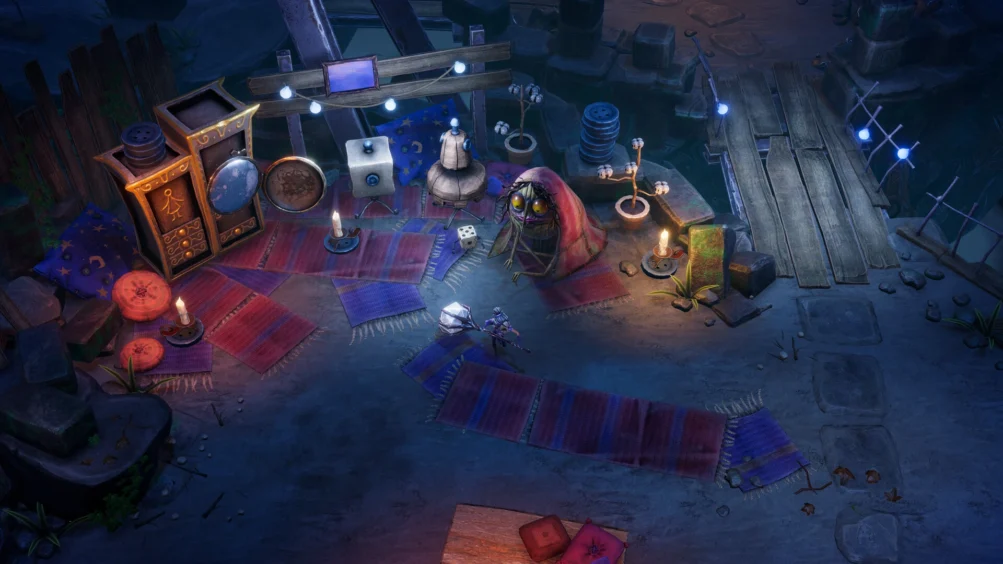
Each playthrough spans four randomly‑generated biomes, each with unique atmosphere and challenges. Exploration rewards curiosity: hidden rooms, mini‑games, NPCs, and upgrades await. Between runs, the Sanctuary lets you spend coins, level up Fortune, and customize your build for next time.
Sanctuary & Progression
Between runs, the Sanctuary offers more than upgrades—it’s a place to reflect, strategize, and reshape your approach. You can invest in Fortune’s abilities, unlock new relic slots, and even tweak card probabilities. It’s here that the roguelike loop tightens: each death becomes a blueprint for your next build, and each upgrade nudges you closer to mastery
Visuals & Sound: Dark Whimsy Refined
Visually, Lost in Random The Eternal Die carries over the original’s Tim Burton‑meets‑Coraline aesthetic with even more polish. The environments feel hand‑crafted despite the procedural layout, with strong lighting, textures, and character design. Audio-wise, a haunting, playful soundtrack and expressive voice acting bring depth—though a few NPCs can yak on a bit. Still, the vibe is rich and immersive.
Balance & Challenge: Just Right, Nearly
According to director Martin Storm, the game ended up slightly easier than intended—but intentionally so. Difficulty is tuned so learning curves smooth out early runs, ramping gradually with enemy variety and relic complexity.
A full run typically lasts about two hours and rewards persistence over perfection.
The Flow: Addictive, with Some Repetition
The loop can feel repetitive—you’ll replay rooms, reroll relics, and repeat builds. But for fans of roguelikes, the randomness is part of the appeal. A failed run becomes a lesson, and the next build might just feel unstoppable. Still, pacing can drag if relic drops don’t favor your strategy or if rooms repeat too often.

Final Verdict
Lost in Random The Eternal Die doesn’t rehash the original’s slower narrative adventure. Instead, it embraces randomness, strategy, and roguelike replayability with striking style and polish. It’s not perfect—some combat runs feel grindy, and pacing can stutter—but its charm, depth, and tactical satisfaction make it a worthy evolution.
If you like dice, builds, gothic fairytales, and roguelike challenges rolled into one stylish package, this is your game.
Lost In Random The Eternal Die Trailer
Read more awesome reviews >>here<<.
Game code was provided by the Publisher.
I reviewed it, and then it was edited by my partner.



You must be logged in to post a comment.