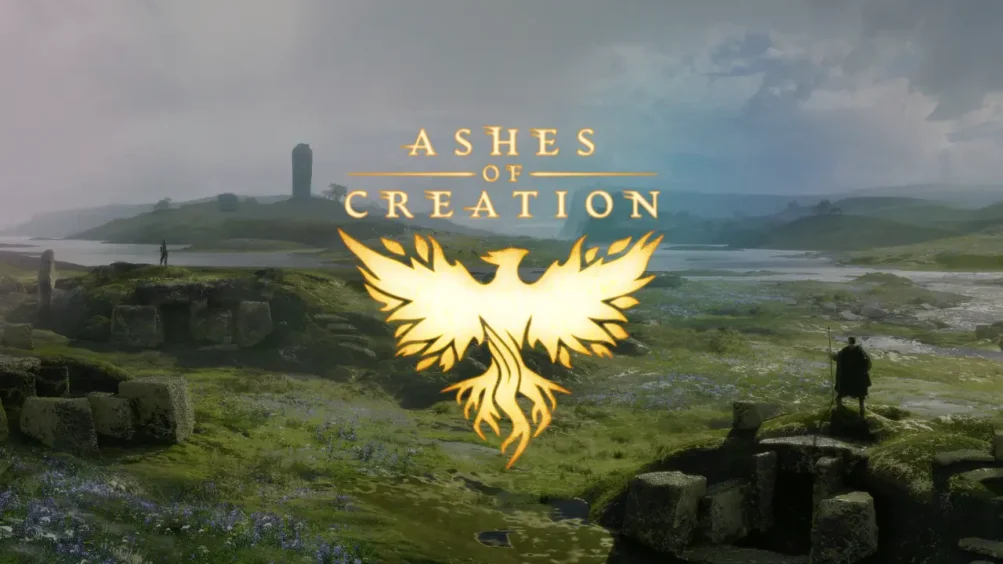
For a while, Ashes of Creation felt like the MMO that might finally stop the genre from eating itself.
Not another theme park chasing nostalgia. Not another seasonal reset pretending to be progress. This was meant to be a living world — one shaped by players, scarred by failure, and permanently changed by success. In a genre that had grown safe and predictable, Ashes didn’t just promise something new. It promised something risky.
For years, that promise was enough.
An MMO Genre Running on Muscle Memory
When Ashes of Creation first appeared in 2016, the MMO genre was running on habit rather than excitement. Players logged in because they always had. Expansions brought temporary highs, followed by familiar drop-offs. Innovation existed, but rarely at scale.
Intrepid Studios didn’t ease its way into that space. It kicked the door open with an idea that sounded borderline unrealistic: a node-based world where player activity decided which towns survived, which cities flourished, and which regions vanished entirely.
No safety nets. No static content. No identical servers.
It sounded impossible. That was the hook.
The Kickstarter campaign in 2017 proved how badly players wanted to believe. Millions were pledged, not just to fund a game, but to back the idea that MMOs could still evolve. People weren’t buying access. They were buying faith.
Years of Progress, Years of Excuses
What followed was a long, public development cycle filled with alphas, showcases, reworks, and constant explanation. Systems were introduced, reimagined, and sometimes quietly pulled apart. Combat shifted direction. Timelines stretched. Features slipped.
Supporters called it transparency. Critics called it drift.
To Intrepid’s credit, the vision never fully disappeared. The idea of a reactive world remained the backbone of everything shown. But over time, the distance between how Ashes was talked about and how it actually played became harder to ignore.
Some mechanics felt incredible in theory and underwhelming in practice. Others stayed permanently “in development.” The longer it went on, the harder it became to tell whether the project was refining itself — or struggling to hold together.
Early Access and the Reality Check
By the time Early Access arrived in late 2025, Ashes of Creation was carrying nearly a decade of expectation. This wasn’t just another test. This was meant to show the game could survive in the wild.
It didn’t.
Performance issues were widespread. Bugs interrupted core gameplay. Bots and gold sellers slipped through systems that were supposed to prevent them. Servers buckled under real player numbers. What players found wasn’t a rough gem — it was a foundation that didn’t feel finished.
Early Access lives or dies on trust. Here, trust finally cracked.
When It All Fell Apart
In early 2026, everything unraveled with shocking speed.
Steven Sharif stepped away from the project, pointing to internal disagreements and decisions he could no longer support. Shortly after, reports of mass layoffs at Intrepid Studios surfaced. Developers vanished. Communication slowed. Operations stalled.
The game was pulled from sale.
For a project that had spent years building momentum, the collapse felt sudden and brutal. Backers were left staring at unfinished systems and asking the same question: how did it end this fast?
A Community Split Down the Middle
The fallout fractured the community.
Some accused the studio of overpromising and leaning too heavily on marketing to keep belief alive. Others argued Ashes wasn’t a scam — just an example of ambition running headfirst into reality.
Both sides were disappointed. And both were probably right.
What hurt most wasn’t the lost money or time. It was the feeling that something genuinely different had slipped away. Ashes of Creation wasn’t chasing trends. It was trying to outgrow them.
What Ashes of Creation Leaves Behind
Today, Ashes of Creation stands as a warning — not against dreaming big, but against letting vision outrun execution.
It shows how fragile community trust can be, how quickly patience runs out, and how brutal reality becomes when long-term ambition meets financial and technical limits.
But it also proves something else: players still want MMOs that matter. Worlds with consequences. Servers with identity. Stories created by communities, not patch cycles.
That desire didn’t die with Ashes of Creation. It was simply left unanswered.
Final Thoughts
The rise and fall of Ashes of Creation isn’t just about one game failing to launch. It’s about a genre searching for its next step, a studio reaching too far, and a community willing to believe far longer than most.
For a brief moment, it felt like the future of MMOs was being written.
Instead, Ashes of Creation became a reminder that ambition alone isn’t enough — and that even the brightest ideas can burn out before they ever fully catch fire.
If you enjoy games and gaming and want more NEWS from the Gaming World Click Here