You can’t pick your map in Apex Legends. Here’s how the rotation works across its modes, and how to see what’s live before you queue.
Most shooters let you vote, choose or at least see a list. Apex Legends doesn’t. When you press ready in Battle Royale, the game has already decided where you’re going, and the only way to play a particular map is to wait for it to come round. For a game with six Battle Royale maps in its pool, that’s a design choice with real consequences for how people play.
Each mode has its own rotation
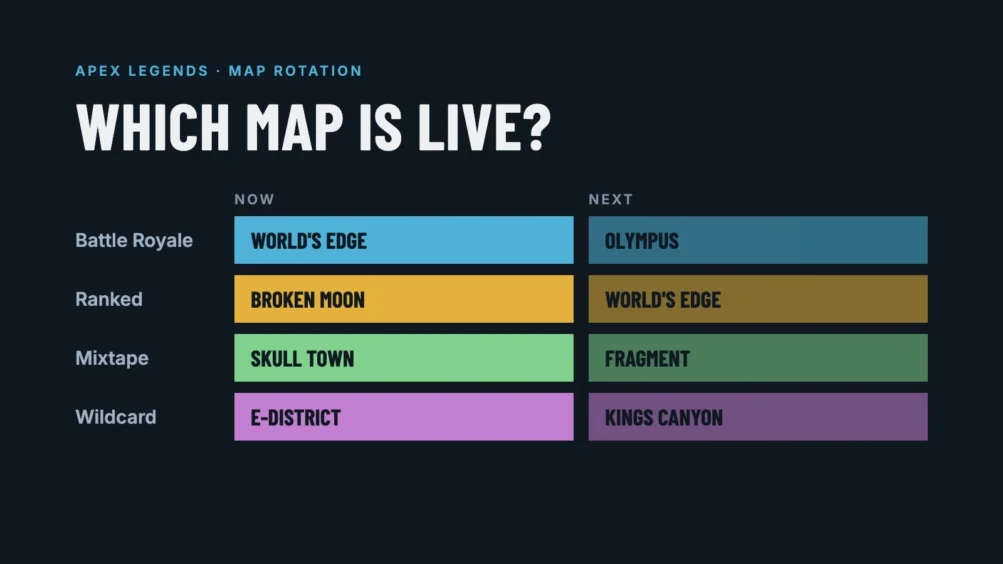
The rotation isn’t one global list. Battle Royale, Ranked, Mixtape and Wildcard each run their own schedule, and they don’t line up with one another. At any given moment, casual Battle Royale might be on World’s Edge while Ranked is on Broken Moon and Mixtape is running a small arena-style map like Skull Town or Fragment.
The Battle Royale pool currently covers Broken Moon, E-District, Kings Canyon, Olympus, Storm Point and World’s Edge. Not every map is in every mode’s list at once. Respawn adds and removes maps from rotations as seasons change, and a map that sat out for months can come back with new points of interest.
Mixtape and Wildcard are the pressure valve
The smaller modes are where the rotation feels least restrictive. Mixtape cycles through compact maps such as Skull Town and Fragment, with quick respawns and short matches, so a bad map only costs you a few minutes. Wildcard runs its own Battle Royale rotation, which at times puts a different large map on offer than the main playlist. If the main queue is on a map you can’t face, one of these is often a better use of a short session than sitting it out.
Ranked moves more slowly
Ranked runs on a slower cycle than the casual playlists. That’s deliberate. Ranked players are putting points on the line, and a map that stays live for longer gives them time to settle into routes, rotations and drop spots rather than starting from scratch every time the playlist flips.
It also means that if you dislike the current Ranked map, waiting it out takes patience. Plenty of players switch to casual Battle Royale for a while, or use the time to practise somewhere else, rather than grinding a map they don’t enjoy.
Why there’s no map choice
The case for a fixed rotation is mostly about matchmaking. Splitting the player base across six maps at once would mean thinner queues on each, longer waits and wider skill gaps inside each lobby. One live map per mode keeps everyone in the same pool.
There’s a design argument too. Apex maps are big, and each one has its own logic: where the high-tier loot sits, which areas get boxed in by the ring, how long it takes to cross from one side to the other. Forcing players onto maps they wouldn’t choose means more of them end up learning all six rather than living on a single favourite.
The cost is obvious to anyone who logs on for a short session. If you’ve got half an hour and the map you hate is up, there isn’t much you can do about it.
Checking what’s live before you queue
The simplest fix is to look before you load in. The in-game lobby shows the current map for the mode you’ve selected, but not what’s coming next or how long is left. That’s the part that matters if you’re deciding whether to play now or come back later.
Third-party trackers fill that gap. An Apex Legends map rotation page shows what’s live in each mode right now, what comes next and how long until it changes, with times in UTC. Keeping one open on a second screen or a phone takes the guesswork out of planning a session around a map you actually want.
It’s useful for squads too. If three friends are trying to coordinate a Ranked evening, knowing when the map changes makes it easier to pick a start time that suits everyone.
Getting the most out of a map you don’t like
Sometimes the rotation just doesn’t go your way. A few habits help.
Treat it as practice. Every map you avoid is one you’ll be worse on when it comes up in Ranked, so a few casual games on it now pay off later.
Pick a legend that suits the terrain. Big open maps reward mobility and long sightlines; tighter, more vertical ones favour legends who can hold buildings or reposition quickly. Swapping legend for a rotation is often easier than forcing your main onto a map that works against them.
Learn one drop spot properly rather than hot-dropping somewhere new every game. Knowing where the loot is and how to leave safely turns an unfamiliar map into a manageable one quite quickly.
A rotation is part of the game
Some players would still like a vote. For now, though, the rotation is part of how Apex Legends works, and the players who do best tend to be the ones who stop fighting it. Know what’s coming, plan around it, and use the maps you don’t love as a chance to get better on them.