
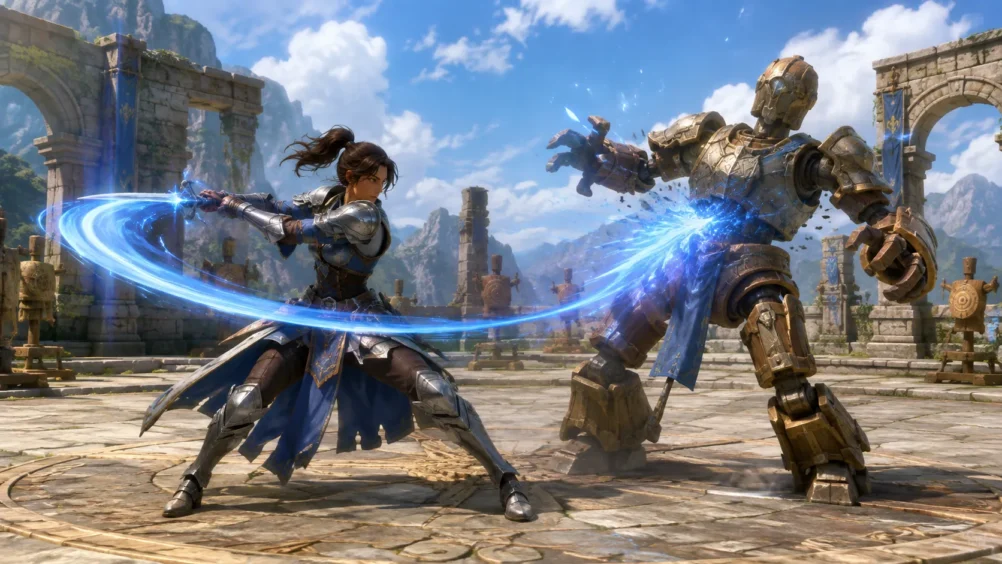
A demo ends just as a game starts making sense. The combat clicks, a character becomes interesting, or an apparently simple quest opens into something larger. Then the purchase screen appears. Whether that moment feels satisfying or irritating depends partly on what the playable section has already delivered.
Choosing where to stop is a design decision. A demo needs to demonstrate enough of the experience for a judgement, while leaving a reason to continue. Dragon Quest VII Reimagined and Final Fantasy XVI show two different ways of managing that balance.
What Survives the Trial Matters
Before the ending arrives, the demo establishes an expectation about progress. A completed quest might become the opening chapter of a permanent save, or exist only inside a temporary sample. That distinction affects how willingly someone explores optional paths or experiments with equipment.
Transferable progress is not a feature of every kind of demo. In demo versions of online pokies, virtual credits allow simulated slot stakes, spins, symbols, bonus rounds and payouts to be explored without placing a real-money wager. The resulting winnings remain in the practice balance and cannot be withdrawn or moved into a paid casino account, so the session provides familiarity with the reels, game rules, controls and feature triggers rather than financial progress.
For a story-driven game, the equivalent question concerns what the eventual purchase will preserve. Clear information about save transfer lets the opening hours feel purposeful instead of leaving their status uncertain.
An Episode Provides a Natural Stopping Point
The Dragon Quest VII Reimagined demo ends after the Ballymolloy storyline, the first world the party visits. Its official Steam description confirms that save data can transfer to the full game, subject to account and system requirements. It also specifies caps on character levels, vocation proficiency and gold.
That combination gives the sample a defined narrative boundary while limiting how far progression can run ahead. The end of a storyline offers a more legible stopping point than a timer expiring halfway through a conversation.
There is an important distinction between finishing an episode and finishing the adventure. An episode can demonstrate how investigation, travel and encounters fit together without resolving every larger question. The player has experienced a meaningful sequence rather than simply completed the controls tutorial.
The caps also make the demo’s boundaries worth explaining. Someone who enjoys repeated battles needs to know that unlimited preparation is not part of the offer, even when the save itself can continue.
A Prologue Cannot Demonstrate Everything
The opening of a long game has competing responsibilities. It introduces characters, establishes a setting and teaches basic actions. More elaborate combat options may appear later, after the player has learned the foundations.
Final Fantasy XVI addresses that problem with two components. Its demo offers the opening story section, followed by a specially prepared Eikonic Challenge. The publisher’s demo listing confirms that the opening save can transfer, while Eikonic Challenge data cannot be saved, loaded or carried into the full release.
This creates two separate jobs for the sample:
- The opening establishes the story and provides progress that can continue.
- The additional challenge offers a dedicated opportunity to assess action gameplay.
- Separate transfer rules distinguish campaign progress from the combat demonstration.
The design acknowledges that a chronological opening may only partly represent the eventual experience. A second component can broaden the sample without requiring the entire campaign introduction to be rewritten.
A Countdown Changes the Way People Play
A time-limited sample asks a different question. Instead of reaching an authored conclusion, the player must decide how to spend a fixed allowance. Reading optional dialogue, checking a menu or repeating a battle all compete with seeing another area.
That pressure can be useful when brevity is deliberate, but it changes what gets tested. A cautious explorer and a confident action player may reach very different stopping points during an identical allocation.
A story boundary gives the developer more control over the final experience. A time boundary gives a clear limit on access, but cannot guarantee that the most representative encounter happens before the clock expires.
Neither approach automatically produces a better demo. The relevant test is whether the restriction supports the kind of game being demonstrated.
The Ending Should Leave Evidence
A strong final moment leaves more than an unanswered plot question. It gives enough practical experience to support a decision about the full game. Four questions help assess whether a sample has done that work:
- Has the main activity been repeated enough to reveal its rhythm?
- Has the player made meaningful choices beyond following instructions?
- Are the sample’s progression limits and transfer conditions clear?
- Does the ending arrive after a useful payoff rather than before one?
If you enjoy games and gaming and want more NEWS from the Gaming World Click Here




You must be logged in to post a comment.