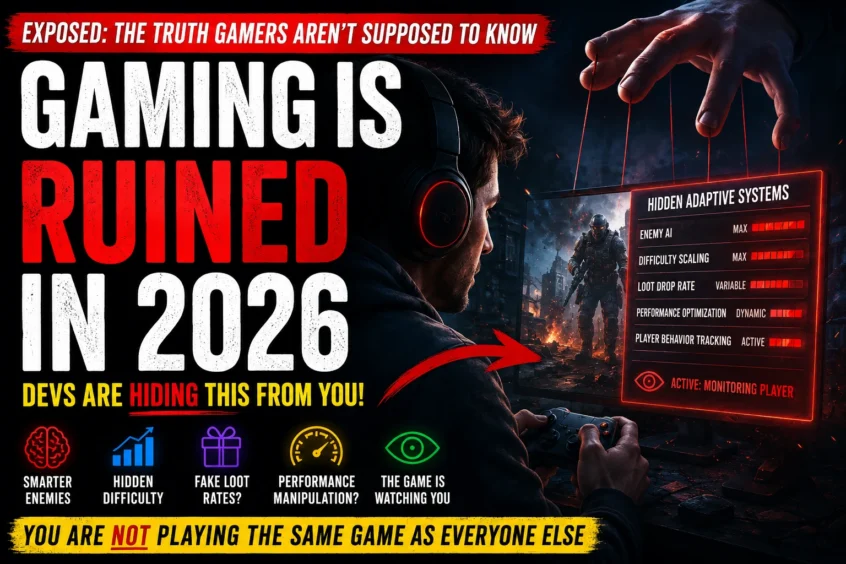
Something Strange Is Happening in Modern Gaming
Something unusual has been making the rounds across gaming communities — and it’s sparked one of the most divisive debates in recent memory.
Players are increasingly claiming that modern games are no longer fixed, predictable experiences. Instead, they believe games may be quietly adjusting themselves in real time based on how they play.
From difficulty spikes to shifting AI behaviour and even changes in loot systems, some gamers argue there is an “invisible hand” shaping their experience moment to moment.
But is this evidence of hidden systems… or just misunderstood modern game design?
Hidden Adaptive Game Systems: The Core Claim
The central idea behind the debate is simple but controversial: hidden adaptive game systems may be altering gameplay without clear player awareness.
According to community discussions, these systems could potentially affect:
- Enemy intelligence and reaction speed
- Loot drop rates and reward frequency
- Difficulty scaling beyond visible settings
- Performance behaviour during gameplay sessions
- Encounter pacing based on player performance
In theory, many of these systems already exist in modern game design — but usually in controlled, transparent ways.
“The Game Changes When I Start Doing Well”
Across forums and social media, players describe similar experiences that fuel the debate.
“When I was struggling, the game felt balanced. When I started doing well, everything suddenly became harder.”
“It feels like the game reacts the moment I adapt.”
These experiences are often shared in good faith, but they are difficult to verify consistently across controlled testing.
In many cases, these perceptions can be influenced by natural gameplay variation, learning curves, and randomness in system design.
Adaptive Difficulty Gaming Is Not New
It’s important to understand that adaptive difficulty gaming is not a new concept.
Many modern titles already include systems designed to adjust challenge levels or player experience. However, these systems are usually:
- Clearly documented in settings or design notes
- Tied to accessibility features or difficulty modes
- Designed to improve engagement rather than manipulate outcomes
The current controversy stems from the belief that these systems may be more dynamic or less transparent than players expect.
Modern Gaming Controversy: Why This Is Trending
The rise of this debate reflects a broader shift in how players analyse games.
Modern gaming is built on complex systems including procedural generation, live-service updates, AI-driven behaviour, and real-time optimisation.
Because of this complexity, players are more likely to interpret unexpected behaviour as intentional design rather than system variance.
At the same time, streaming culture and data-driven gameplay analysis have made players more sensitive to inconsistencies.
Dynamic Game Mechanics vs Player Perception
Many of the claims surrounding dynamic game mechanics can often be explained by existing systems such as:
- Random number generation (RNG)
- AI behaviour variation patterns
- Server latency and performance fluctuations
- Difficulty scaling tied to game progression
These elements can sometimes create the impression that a game is “reacting” directly to the player, even when no such system exists.
Game AI Behaviour and the “Invisible Hand” Theory
Some players argue that modern game AI behaviour feels more responsive and unpredictable than ever before.
This has led to theories that enemies or systems may be adapting specifically to individual players in real time.
While advanced AI systems can create more believable and reactive enemies, there is no verified evidence that mainstream games secretly adjust AI per player in the way some claims suggest.
Live Service Game Systems Add Complexity
The rise of live service game systems has also added fuel to the debate.
Because these games are updated frequently and rely on persistent online infrastructure, player experiences can change over time due to:
- Balance patches
- Server-side updates
- Event-based content changes
- Seasonal adjustments
This evolving structure can make games feel less static than traditional single-player experiences.
So… Are Games Really Changing While You Play?
Despite the growing debate, there is currently no verified evidence that modern games secretly alter core mechanics individually per player in real time.
However, modern design trends do include dynamic systems that can influence difficulty, pacing, and behaviour within defined rules.
The confusion likely comes from the combination of complex systems, randomness, and player perception under pressure.
Final Thoughts
The idea of hidden adaptive game systems makes for a compelling theory, especially in an era of increasingly complex game design.
But while modern games are more dynamic than ever, most of the behaviour players attribute to “invisible manipulation” can be explained through known mechanics and design principles.
Still, as games continue to evolve, the conversation around transparency, fairness, and system visibility is only going to get louder.
If you enjoy games and gaming and want more NEWS from the Gaming World Click Here