The Video Game History Foundation (VGHF) has expanded its free Digital Library with more than 300 photographs documenting Japan’s video game industry during the late 1990s and early 2000s, offering a fascinating look back at an era that helped shape modern gaming.
The newly released Colin Williamson Photography Collection features images captured by the journalist while covering major industry events, interviewing well-known developers and exploring Tokyo’s gaming hotspots. Williamson wrote for publications including IGN and PC Gamer, attending events such as Tokyo Game Show and JAMMA Show while documenting the rapidly evolving Japanese games scene.
Using a digital camera at a time when the technology was still relatively new, Williamson captured everything from major trade show displays to the everyday sights of Tokyo’s gaming districts. These photographs are now available through the VGHF Digital Library, where they can be browsed and used for educational purposes.
Rare Photos Capture a Golden Era of Japanese Gaming
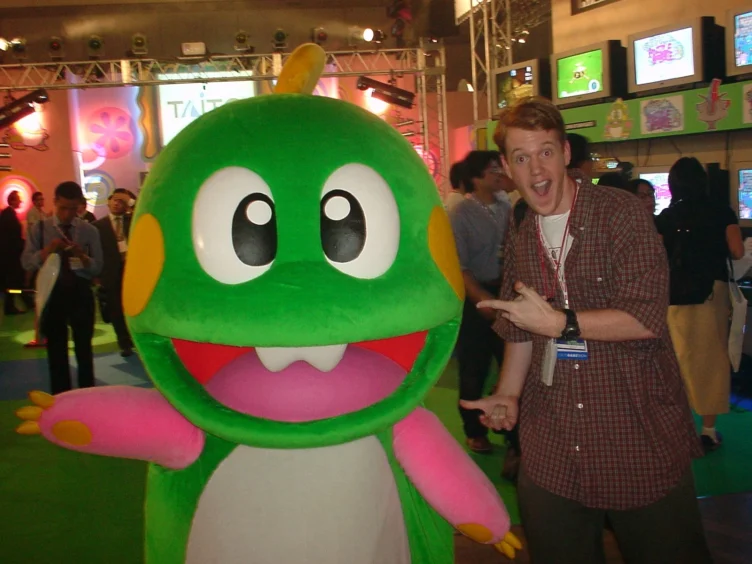
The collection includes photographs of games such as Gran Turismo 3: A-Spec and Shenmue, alongside images from Nintendo’s Space World event, where the company showcased the Game Boy Advance. Other highlights include a Space Channel 5 promotional appearance featuring producer Tetsuya Mizuguchi and photographs of Williamson meeting Bub, the mascot from Bubble Bobble, at Tokyo Game Show 2000.
However, some of the most interesting images focus on the gaming culture surrounding these major events. Williamson documented Tokyo’s streets, particularly Akihabara, preserving details that might otherwise have disappeared over time. From the familiar red exterior of Club SEGA and SEGA Hi Tech Land arcade signage featuring Sonic the Hedgehog to towering stacks of CRT televisions and PC monitors, the photographs offer a glimpse into a very different era of gaming.
Advertisements for games such as Jet Set Radio and Final Fantasy IX also feature in the collection, helping capture the atmosphere of Japan’s gaming scene as it developed around the turn of the millennium.
Phil Salvador, VGHF Library Director, explained that Williamson’s photographs are valuable because they document both the major industry events and the everyday details of Japanese gaming culture. While such scenes might once have seemed ordinary, they have become important historical records decades later.
The foundation says preserving these kinds of cultural artefacts is central to its mission of helping people better understand video game history.
Williamson has also appeared on the VGHF podcast Video Game History Hour to discuss his time covering the Japanese industry and the stories behind his photography. VGHF Patreon members can access an extended bonus section exploring the collection in greater detail.
VGHF Annual Report Highlights Major Preservation Achievements
The photography collection arrives alongside the foundation’s 2026 Impact Report, which details its work over the past year and the progress made possible through donor support.
One of the biggest achievements highlighted in the report is the continued expansion of the VGHF Digital Library. Launched in December 2025, the archive now contains more than 8,000 catalogued items comprising approximately 61,000 individual files, with new collections and historical material continuing to be added.
The foundation has also helped preserve games that might otherwise have been lost. In 2024, it recovered the source code for Xcavator, an unfinished and previously unannounced NES game cancelled in 1991. The code came from the family of the late programmer Chris Oberth. With support from Mega Cat Studios and iam8bit, the game was subsequently made available to purchase, with all profits supporting the foundation’s preservation work.
Another important milestone involved Computer Entertainer, one of the earliest American video game magazines and a publication known for covering home consoles during the mid-1980s. The magazine, which reviewed landmark releases including The Legend of Zelda and Super Mario Bros. around their launch periods, has been fully digitised and made freely available under a Creative Commons licence.
The report also highlights how the foundation’s resources are being used by game developers, historians, journalists, writers and YouTube creators to support their own projects. Meanwhile, additional historical collections are already being prepared for future inclusion in the Digital Library.
VGHF Executive Director Frank Cifaldi said the response to the free archive had exceeded expectations, highlighting the appetite for carefully researched, human-curated video game history. The foundation aims to help people worldwide explore the origins of the industry and give researchers and content creators access to resources that might otherwise remain difficult to find.
VGHF Winter Fundraiser Begins in December
The foundation is also preparing its annual Winter Fundraiser, which is scheduled to begin on 1 December, Giving Tuesday, and run throughout the month.
The campaign is one of the VGHF’s key fundraising initiatives, with plans to release videos and blog articles exploring influential figures in video game history alongside intriguing cancelled projects. Further details are expected to be announced in the coming weeks.
Players, collectors and gaming historians interested in supporting the preservation of the industry’s past can visit the Video Game History Foundation’s official website to explore its work and find out how to contribute.
The new Colin Williamson collection is a reminder that video game history is about more than the games themselves. The arcades, advertisements, trade shows and everyday places surrounding them are all part of the story, and preserving them gives future generations a better understanding of how gaming became what it is today.
If you enjoy games and gaming and want more NEWS from the Gaming World Click Here