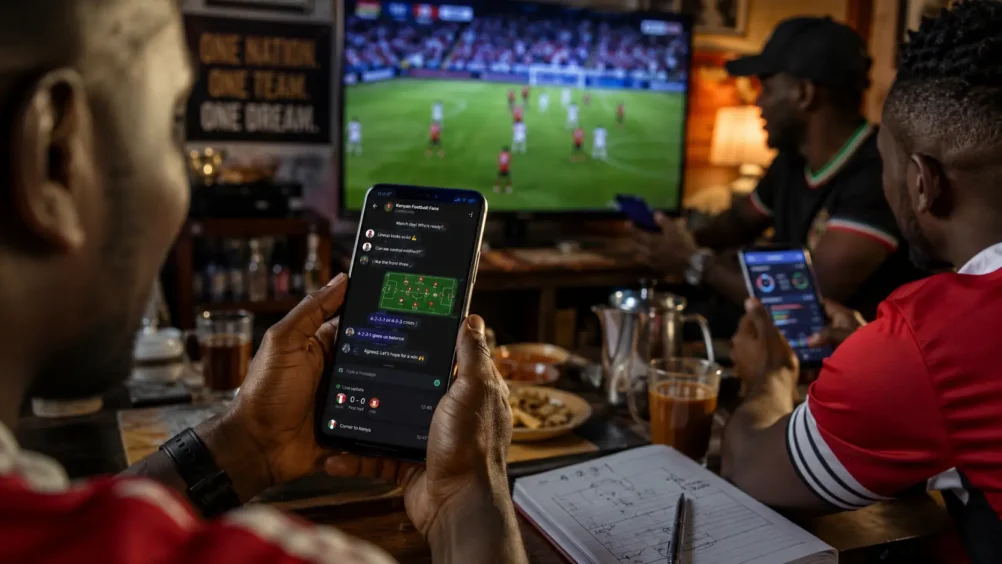
The first AFCON 2027 group-stage window is already built for busy football chats. Current Goal listings place Kenya–Eritrea, South Africa–Guinea, Côte d’Ivoire–Ghana, Tunisia–Uganda, and Senegal–Mozambique on September 23, while CAF officially confirms only that Matchdays 1 and 2 must fall between September 21 and October 6. Those individual dates should therefore be reconfirmed with CAF and the national federations before matchday. For Kenyan communities, Harambee Stars provide the local argument while several heavyweight African fixtures run beside it.
Twelve groups create dozens of simultaneous arguments
CAF placed 48 national teams into 12 groups of four, with Kenya sharing Group D with South Africa, Guinea, and Eritrea. Because Kenya is already qualified as a 2027 co-host, only the highest-ranked non-host in Group D can take the additional finals place, so supporters can discuss Harambee Stars without losing sight of the South Africa-Guinea-Eritrea race. The same special rule applies to Uganda’s Group H and Tanzania’s Group L. One live table can therefore mean something different from the next.
Predicted lineups turn messaging groups into scouting rooms
A national-team week creates information gaps that club football rarely has: players arrive from different leagues, training access is limited, and a late fitness issue can change the front three within hours. WhatsApp and Telegram groups usually fill that space with predicted lineups, screenshots from training, local reporter posts, and arguments over whether a midfielder should start as a No. 6 or higher up the pitch. The useful communities separate an official federation update from a recycled screenshot before passing it along. Four hours before kickoff, source quality matters more than message volume.
The second screen now carries half the matchday conversation
Kenya’s 84.1 million active mobile subscriptions show the scale of the infrastructure behind this behavior, even though that figure includes multiple SIM ownership rather than 84.1 million individual users. During a live qualifier, supporters may keep a score app, statistics feed, news account, group chat, and sportsbook within the same phone session; existing users considering the Melbet app for Android can place it within that stack rather than treating it as the center of the viewing experience. The operator’s documentation lists pre-match and live markets, mobile access, and sports statistics, while the Kenyan regulator’s published 2025/26 register lists Game Tosha Limited trading as Melbet; users should confirm its current 2026/27 status before betting. The football still supplies the information that should drive any wagering decision.
Odds debates are really arguments about probability
A group chat saying Kenya should be 1.60 rather than 1.80 is making a probability claim whether anyone uses that language or not. The better discussion asks what changed: a confirmed striker absence, a different goalkeeper, a venue update, or a tactical mismatch offers evidence, while ten people repeating the same prediction does not. Live markets add another layer because one red card or early goal changes both game state and price. Consensus is not data.
Fast access helps only when the source is worth opening
Matchday users often optimize for speed after the first goal because they want the group table, scorer, card count, and new odds without leaving the broadcast for long. For a supporter who already uses a localized service, choosing to get the app can reduce browser steps, but it should sit beside official CAF or federation updates rather than replace them. A phone notification saying a player is doubtful has less value than the confirmed XI, and a moving total has less meaning without knowing whether the game itself has opened up. The fastest tap should still lead to the strongest information source.
Community memory improves the next prediction
Digital football groups become more useful when someone remembers what the group predicted before kickoff rather than only celebrating the correct calls afterward. If Kenya creates few central chances against Eritrea despite heavy possession, that tactical note could become relevant in the following qualifier against Guinea once the final dates and venues are confirmed. The same review applies to Côte d’Ivoire–Ghana or Tunisia–Uganda: record which assumptions held, which collapsed, and whether the market moved for a visible football reason. Screenshots make hindsight harder to rewrite.
November will test which communities learned anything
CAF has already reserved November 9–17 for Matchdays 3 and 4, so September is the first data set rather than a self-contained event. Groups that track lineup accuracy, tactical changes, injuries, and price movement will enter November with a record of what their analysis actually got right. Groups that only count winning predictions will carry less useful information into Kenya’s next fixtures. The archive is the advantage.