
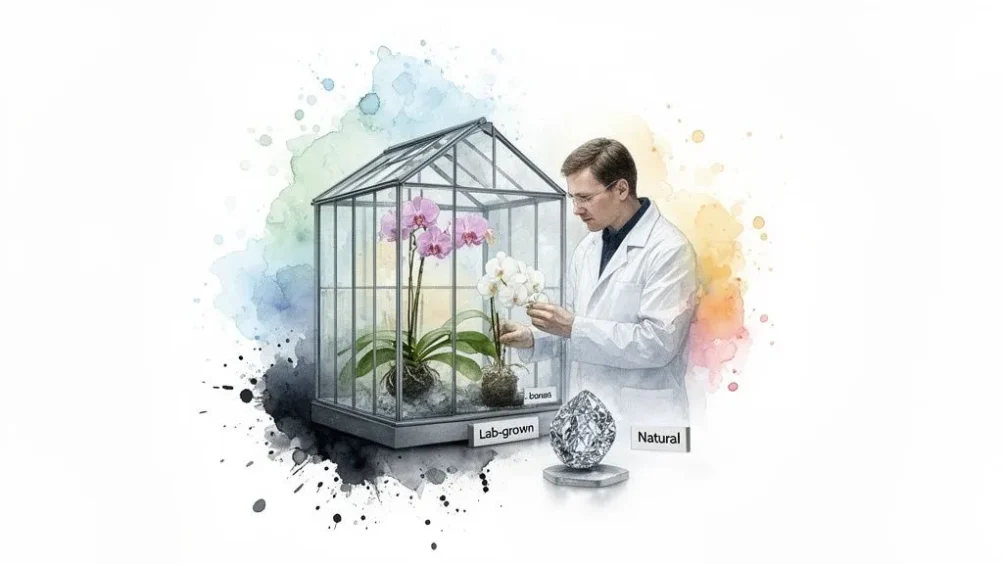
Think of it this way: is a stunning orchid grown in a perfectly controlled greenhouse any less real than one discovered in the wild? Of course not. The same holds true for lab-grown diamonds. They are genuine diamonds, created by replicating the earth’s natural process, just on a much faster timeline.
The Blueprint for a Modern Diamond
Let’s get one thing straight right away: lab-grown diamonds are not fakes or look-alikes such as cubic zirconia. They are real diamonds through and through. They share the exact same carbon atom crystal structure, the same fiery brilliance, and the same hardness as diamonds pulled from the earth. The only thing that separates them is their origin story.
So, how exactly is this possible? Let’s walk through the two primary methods used to create these marvels of science. Understanding the process makes it clear why they’ve become such a compelling choice for discerning clients in London and beyond who want both breathtaking beauty and a clear conscience.
A New Chapter in Gemology
While the idea of making diamonds isn’t new, recent technological leaps have made it possible to grow gem-quality stones that are indistinguishable from the finest mined diamonds. This isn’t just a scientific achievement; it’s a turning point for the jewellery industry, offering a fully transparent and ethical alternative. For our clients at MoonOcean, it means access to incredible diamonds with a guaranteed, conflict-free history.
The creation process essentially follows one of two recipes:
- High-Pressure/High-Temperature (HPHT): This method mimics the intense heat and crushing pressure deep within the Earth’s mantle-nature’s original diamond forge.
- Chemical Vapor Deposition (CVD): A newer technique, CVD builds the diamond layer by layer, atom by atom, inside a specialized vacuum chamber.
No matter the method, it all starts with a tiny diamond “seed.” This is a microscopic sliver of a pre-existing diamond that acts as the template, ensuring the new crystal grows with the exact same atomic lattice as a natural stone.
We’ll explore both of these incredible processes in more detail, lifting the curtain on the science behind the sparkle. This knowledge helps you make a choice that aligns with your values without ever sacrificing quality. Here at MoonOcean, we truly believe this is the future of fine jewellery, and we invite you to see the magnificent results for yourself.
Recreating Earth’s Force with the HPHT Method
Think of the High-Pressure/High-Temperature (HPHT) method as the original recipe for lab-grown diamonds. It’s a staggering feat of engineering, like building a tiny, precision-controlled volcano right in a lab. The whole idea is to perfectly mimic the intense conditions deep inside the Earth’s mantle, where nature forges diamonds over billions of years.
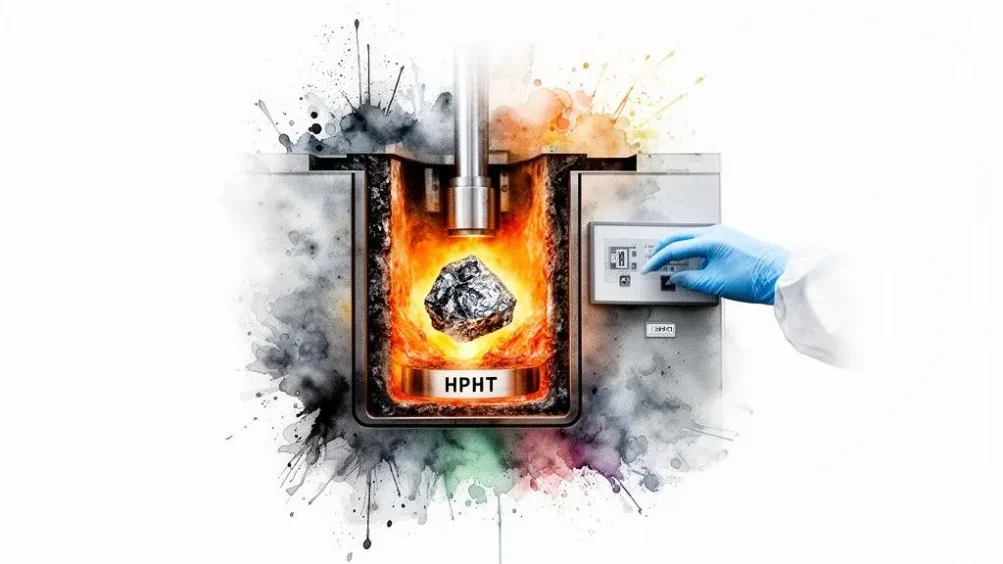
The journey from simple carbon to a stunning diamond starts with something surprisingly small: a diamond ‘seed.’ This is just a microscopic slice of an existing diamond that acts as the blueprint for the new crystal. Without this template, the carbon atoms would have nowhere to arrange themselves, and you’d never get that perfect diamond structure.
We take this tiny seed and carefully place it in a growth cell along with a source of pure carbon-usually high-purity graphite, the same stuff you find in a pencil. This entire capsule is then set inside a massive press built to generate almost unimaginable force.
The Diamond Forging Process
With everything in place, the machine whirs to life, kicking off a growth cycle that can last several weeks. It’s a carefully choreographed dance of physics and chemistry that transforms basic carbon into a brilliant gem. The level of control we have is precisely why the quality is so consistently fantastic.
Here’s a look at what happens inside that press:
- Applying Immense Pressure: First, the press squeezes the growth cell with about 5-6 gigapascals (GPa) of pressure. To give you a sense of that, it’s like balancing a jumbo jet on your fingertip.
- Introducing Intense Heat: At the same time, the cell is blasted with heat, reaching temperatures between 1,400 and 1,600 degrees Celsius. This powerful combination of heat and pressure melts the graphite into a liquid carbon bath.
- Crystallization and Growth: Now free to move, the carbon atoms are naturally drawn to the slightly cooler, more stable diamond seed. They begin to attach themselves, one by one, falling perfectly into line with the seed’s crystal lattice.
This atom-by-atom buildup continues for two to four weeks, slowly constructing a new, much larger rough diamond around that original seed. It’s a slow, deliberate process that ensures the diamond grows with a beautiful structure and very few flaws. You can discover more insights about these specific conditions and how this science helps make diamonds more accessible, often costing 20-40% less than their mined counterparts.
What Makes HPHT Diamonds Special
Because HPHT diamonds are born in such a controlled, uniform environment, they’re known for their fantastic quality. The rough crystal typically grows into a cuboctahedron shape, which looks a lot like many natural diamond roughs. This method is especially good at creating high-clarity, colourless stones.
The HPHT process is a marvel of applied physics. By exactly replicating the conditions that create diamonds in nature, we can produce gems that are chemically, physically, and optically identical to those mined from the earth.
As a bonus, the HPHT method can also be used to improve the colour of certain diamonds, turning stones with a brownish tint into brilliant, colourless gems or even stunning fancy colours. This versatility has made it a true cornerstone of the lab-grown diamond industry, reliably delivering the fire and sparkle that people have always loved.
At MoonOcean in London, we celebrate this perfect blend of science and artistry. For a personal viewing of our exquisite lab-grown diamond collection, we invite you to our affiliated showroom.
Building a Diamond Atom by Atom with CVD
If the HPHT method is about recreating nature’s brute force, then Chemical Vapour Deposition (CVD) is its high-tech, precision-focused counterpart. Forget volcanoes; think more along the lines of atomic 3D printing. It’s a newer technique that literally builds a diamond from the ground up, one perfect layer of carbon at a time.
The whole approach is completely different from HPHT. Instead of crushing carbon into a diamond, CVD coaxes individual carbon atoms into forming a flawless crystal. The starting point, though, is the same: a tiny, paper-thin diamond seed.
This little slice of diamond-which can be either natural or lab-grown itself-is carefully placed inside a sealed vacuum chamber. This chamber is the clean-room environment where the entire microscopic construction process takes place.
The Science of Atomic Rain
With the seed in place, the real action begins. Scientists fill the chamber with carbon-rich gases, usually a mix of methane and hydrogen, which provide the raw building blocks for the new diamond.
Next, they bombard the chamber with energy, typically microwaves, heating the gases until they ignite into a fiery ball of plasma. This superheats the gas, breaking the molecules apart and freeing the individual carbon atoms.
What follows is like a gentle, perfectly controlled “rain” of pure carbon onto the seed below.
- Atom Liberation: The intense microwave energy strips the carbon atoms from the gas molecules, letting them float freely inside the chamber.
- Deposition on the Seed: These newly freed carbon atoms are then drawn down to the much cooler diamond seed plate.
- Layered Growth: As they land, they bond to the seed’s surface, aligning perfectly with its crystal structure. This process repeats over and over for several weeks, building the diamond atom by atom, layer by meticulous layer.
This painstaking layering gives scientists an incredible degree of control over the final diamond. In fact, as we move through 2026, the CVD market continues to grow rapidly, largely because manufacturers prefer its lower energy use and the constant technological advancements. You can read the full research about lab-grown diamond market trends to see just how much this method is shaping the industry.
Advantages of the CVD Method
So, what does all this precision get you? For starters, diamonds with exceptional purity. The growth environment is so clean and controlled that the resulting stones are often Type IIa diamonds-a classification so rare that less than 2% of all natural diamonds ever make the grade.
The CVD process is the embodiment of precision. By carefully managing gas composition, temperature, and pressure, we can guide the growth of a diamond with incredible accuracy, leading to stunning clarity and even the creation of rare fancy coloured diamonds.
This control also opens the door to creating breathtaking fancy coloured diamonds. By introducing tiny amounts of other elements into the chamber during growth-like nitrogen for a stunning yellow or boron for a deep blue-we can produce stones with vibrant, perfectly uniform colour. It’s this level of scalability and efficiency that is making CVD a go-to method for creating some of the most beautiful diamonds you can find today.
HPHT vs. CVD: Which Method Makes the Better Diamond?
So, we have these two incredible techniques for growing diamonds, HPHT and CVD. A common question we get is, “Which one is better?” The honest answer is that neither is inherently superior. It’s more about understanding the subtle differences and appreciating the unique signature each process leaves on the diamond.
Think of it like this: one method isn’t “better” than the other, they’re just different paths to the same beautiful result. A trained gemologist can often spot the tell-tale signs of a diamond’s origin under a microscope. For instance, some HPHT diamonds might have minuscule metallic inclusions-tiny leftovers from the metal catalyst that helped them form. CVD diamonds, on the other hand, might show very faint layering or striations from their atom-by-atom creation. These are not flaws, but birthmarks that tell the story of their creation.
Key Differences in Process and Outcome
While both methods produce chemically and physically identical diamonds, their distinct approaches result in different characteristics. HPHT is a brute-force method, mimicking the earth’s immense pressure. CVD is more of a delicate, methodical process, building the diamond one layer at a time. These differences influence everything from the energy used to the types of diamonds they’re best at creating.
At MoonOcean, we believe that the more you know, the more confident you’ll feel about your choice. Here are the main distinctions to keep in mind:
- Energy and Equipment: The HPHT process requires a huge amount of energy in one massive burst and relies on incredibly expensive machinery. CVD is also an energy-intensive process, but it generally uses less power over its longer growth cycle, which is one reason it has become so popular.
- The Final Diamond: HPHT has long been the go-to for producing beautiful, colourless diamonds with high clarity. CVD technology, however, truly shines in creating Type IIa diamonds-a classification of purity so high that it includes less than 2% of all natural diamonds. It’s also exceptionally well-suited for creating stunning fancy coloured diamonds.
- Finishing Touches: It’s not uncommon for lab-grown diamonds to undergo a final treatment to perfect their appearance. Some CVD-grown diamonds, for example, are put through a final HPHT process to improve their colour, combining the best of both worlds.
This infographic gives you a great visual breakdown of the CVD process, showing how a tiny diamond seed blossoms into a brilliant gem.
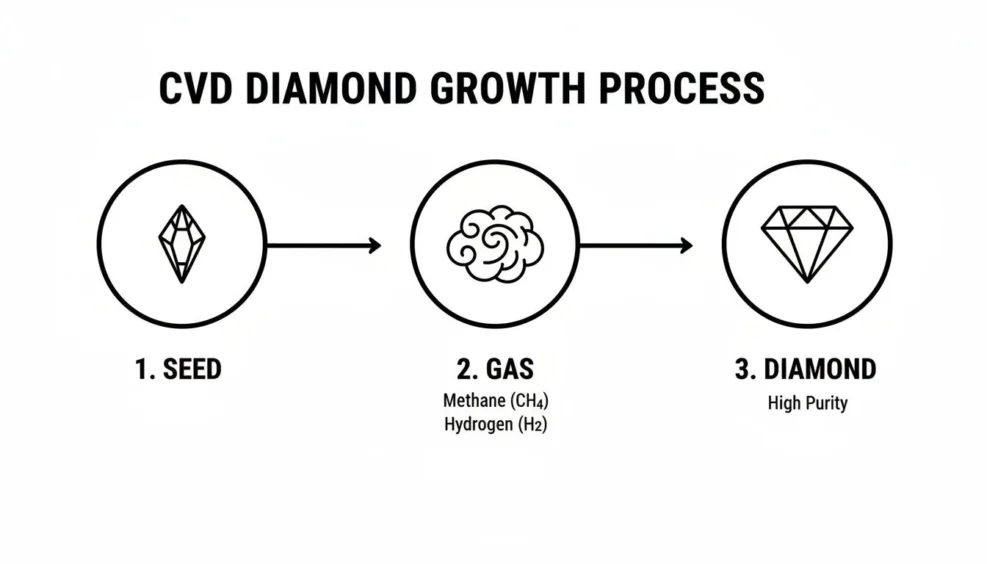
You can really see the clean, layered growth that defines the CVD method, which is why these diamonds are known for their exceptional purity.
HPHT vs. CVD: A Detailed Comparison
To make things even clearer, here’s a side-by-side look at the two methods. This table breaks down the core attributes of the diamonds each process produces, helping you understand their unique profiles at a glance.
| Attribute | HPHT Diamonds | CVD Diamonds |
| Growth Method | High Pressure, High Temperature. Replicates earth’s conditions. | Chemical Vapour Deposition. Builds diamond in layers from gas. |
| Typical Shape | Usually grow in a cuboctahedron shape. | Usually grow in a flat, tabular (square) shape. |
| Common Inclusions | May contain metallic flux inclusions from the catalyst. | May have small, dark carbon spots or graphitic inclusions. |
| Purity & Type | Often Type Ib or Type IIa/IIb after treatment. | Predominantly Type IIa, known for exceptional purity. |
| Colour Range | Excellent for colourless (D-F) and near-colourless diamonds. | Versatile; creates high-purity colourless and fancy coloured diamonds. |
| Post-Growth Treatment | Sometimes irradiated or annealed to create fancy colours. | Often treated with HPHT to improve colour and remove brown tints. |
| Cost & Energy | High initial setup cost and intense energy consumption per run. | Lower setup cost and generally less energy-intensive over time. |
Ultimately, this comparison shows that both methods are masters of their craft, each with its own set of strengths that appeal to different needs and preferences.
What This Means for Your Choice
At the end of the day, whether you choose an HPHT or a CVD diamond comes down to personal preference. Both are real diamonds, and both are graded by the same independent gemological labs using the exact same standards as mined diamonds. A grading report from an institution like the GIA or IGI will always state the diamond’s origin and specify the growth method, giving you complete transparency.
Neither method is better-they are simply different recipes for the same brilliant result. Both produce authentic diamonds that are physically, chemically, and optically identical to those found in the earth.
Knowing the journey your diamond took, from a tiny seed to a brilliant gem, adds another layer of appreciation for its beauty and the incredible technology behind it. It allows you to choose your stone with total confidence.
Certifying the Brilliance of Lab-Grown Diamonds
So, you have a stunning diamond, but how do you really know its quality? Whether it was formed deep in the earth or in a state-of-the-art lab, every diamond needs an impartial evaluation. This is where a gemological certificate comes in, acting as a diamond’s official report card.
One of the most common questions we hear is whether lab-grown diamonds are graded as rigorously as mined ones. The answer is a resounding yes.
The world’s top gemological labs, like the International Gemological Institute (IGI) and the Gemological Institute of America (GIA), use the exact same playbook for both. They evaluate every stone against the universal standard known as the 4Cs, giving you a complete and unbiased picture of its quality.
Understanding the 4Cs of Quality
The 4Cs-Cut, Colour, Clarity, and Carat-are the absolute foundation of diamond grading. Each one tells a crucial part of the diamond’s story and directly impacts its beauty and value. It’s a transparent system that breaks down exactly what makes your stone special.
Here’s what the experts look for when they grade a lab-grown diamond:
- Cut: This is arguably the most critical “C.” It has nothing to do with the diamond’s shape (like round or pear) but everything to do with how well it’s been faceted. A masterfully cut diamond acts like a hall of mirrors, capturing and reflecting light to create that breathtaking sparkle. It’s all about performance.
- Colour: The colour grade is actually about the absence of colour. The scale runs from D (completely colourless and most sought-after) down to Z (a noticeable yellow or brown tint). A diamond with less colour is like a crystal-clear window, allowing more light to pass through it.
- Clarity: This “C” measures a diamond’s purity. Gemologists look for tiny imperfections, known as inclusions (internal) and blemishes (external). The scale goes from Flawless (FL), meaning no imperfections are visible even under 10x magnification, to Included (I3). Think of them as a diamond’s unique birthmarks.
- Carat: Carat is simply a measure of weight, where one carat equals 200 milligrams. While a higher carat weight means a heavier-and often more expensive-stone, it’s the cut that truly determines how large the diamond appears to the eye.
Why Certification Is Your Guarantee
A grading report from a reputable lab isn’t just a piece of paper; it’s your proof of quality and authenticity. It’s a detailed blueprint of your diamond’s DNA, confirming that it has been independently scrutinized by a team of experts. To ensure total transparency, these reports will always disclose the diamond’s origin, clearly stating that it is laboratory-grown.
A diamond certificate is the ultimate promise of quality and transparency. It guarantees that the diamond you are purchasing has been rigorously evaluated by an independent third party, ensuring its characteristics meet the highest industry standards.
Here at MoonOcean in London, we’re built on that kind of transparency. We believe you deserve to know every detail about what you’re buying, which is why we only offer independently certified, high-quality diamonds. It’s our way of making sure your choice isn’t just beautiful, but also backed by proof.
The Clear Choice for Conscious Luxury
Let’s be honest, the sparkle of a lab-grown diamond is physically identical to a mined one. But for many, its true beauty lies in something you can’t see with the naked eye: a clear conscience. Choosing a lab-created diamond is about more than just getting a beautiful stone; it’s about picking a piece of luxury that reflects your values. It’s a commitment to ethics and a lighter touch on our planet, a principle we hold dear at MoonOcean.
The story of how lab-grown diamonds are made couldn’t be more different from that of traditional mining. One is a tale of scientific innovation in a clean, controlled setting. The other is too often linked with ecological damage and murky supply chains. By embracing science, you get to sidestep the heavy baggage that has historically shadowed the diamond industry.
This isn’t just a trend. It’s a fundamental shift in how we think about our purchases. It’s about celebrating life’s biggest moments with a stone that’s as pure in its origins as it is in its brilliance.
An Environmentally Friendlier Footprint
When you dig into the details, the environmental case for lab-grown diamonds becomes crystal clear. Diamond mining is a massive undertaking, involving the excavation of tons upon tons of earth just to uncover a few carats of rough diamonds. The result is often scarred landscapes and disrupted ecosystems that may never fully recover.
Creating a diamond in a lab, on the other hand, leaves a much smaller footprint. The whole process sidesteps the need for large-scale earthmoving, which helps preserve natural habitats.
Here’s a quick breakdown of the sustainable benefits:
- Reduced Land Disturbance: For every single carat pulled from the earth, mining can disturb nearly 100 square feet of land. Lab-grown diamonds are created with a tiny fraction of that physical impact.
- Lower Carbon Emissions: While creating anything takes energy, labs are getting smarter and more efficient all the time. Many are now powered by renewable energy, putting them miles ahead of the fuel-guzzling heavy machinery required for mining.
- Minimal Water Usage: Mining operations are incredibly thirsty, consuming massive amounts of water. Lab-grown diamonds are far more conservative, with some reports showing they use as little as 18 gallons per carat compared to over 126 gallons for a mined stone.
These numbers paint a compelling picture of a more sustainable future for jewellery-one where we don’t have to choose between beauty and the well-being of our planet.
Guaranteed Conflict-Free Origins
Perhaps the most powerful reason to choose a lab-grown diamond is the absolute certainty it provides. The term conflict diamond-gems mined in war zones and sold to fund violence-is a dark cloud that has hung over the industry for decades. Even with regulations like the Kimberley Process, the long and complex journey of a mined diamond can make its true origin difficult to trace.
With a lab-grown diamond, there is zero ambiguity. Every stone is inherently conflict-free. Its journey from a tiny diamond seed to a finished gem is completely transparent and documented.
This isn’t just a marketing point; it’s a guarantee. It means the symbol of your love and commitment is completely untainted by conflict or human suffering. This level of assurance is what today’s buyers expect, and frankly, what they deserve.
At MoonOcean in London, we believe the future of luxury is where beauty and responsibility go hand in hand. The story of how lab-grown diamonds are made is a perfect example of that ideal in action.
Common Questions About Lab Grown Diamonds
Even after learning the science behind how they’re made, a few key questions almost always come up. It’s smart to be curious, so let’s walk through the most common ones to make sure you have all the facts.
Are Lab Grown Diamonds Considered Real Diamonds?
Let’s get the biggest question out of the way first: Yes, they are 100% real diamonds. They are not fakes, simulants, or imitations like cubic zirconia.
A lab-grown diamond shares the exact same DNA as a mined one-it has the identical chemical, physical, and optical properties. Both are pure, crystallised carbon, which is why they have the same stunning brilliance and are the hardest substance on earth. The only thing that separates them is their origin story, and that’s why top gemological labs like the GIA and IGI grade and certify them as real diamonds.
Can an Expert Tell the Difference Just by Looking?
Nope. Not even a seasoned gemologist with a jeweller’s loupe can spot the difference. You could place a top-quality lab diamond next to a flawless mined diamond of the same grade, and they would be visually indistinguishable.
The subtle differences in their growth patterns are only visible at an atomic level. Identifying them requires highly specialised equipment found only in major gemological laboratories. This is why a grading report is so crucial-it provides total transparency by always disclosing the diamond’s origin.
Why Are Lab Grown Diamonds More Affordable?
The price difference has everything to do with the supply chain, not the quality. Think about it: mining for diamonds is a massive, incredibly expensive undertaking. It involves geological surveys, heavy machinery, enormous labour costs, and a long chain of command before a stone ever reaches a showroom.
Creating a diamond in a lab is a feat of technology, but it’s a much more direct and efficient process. This shorter supply chain cuts out the middlemen and the immense overhead of mining, allowing lab-grown diamonds to be priced significantly lower-often giving you 20-40% more size or quality for your budget.
This efficiency is a game-changer. It means you can get a bigger, more brilliant diamond for your money, making that dream piece of jewellery a reality.
Do Lab Grown Diamonds Retain Their Value?
The real value of a lab-grown diamond is what you get on the day you buy it: more size, better clarity, or a higher colour grade for your money. While the resale market for lab diamonds is still young compared to the centuries-old mined diamond industry, their primary benefit is the incredible upfront savings.
It’s best to think of them as a purchase for personal enjoyment and lasting beauty, not as a financial investment. The immediate value you receive allows you to celebrate life’s biggest moments with a truly breathtaking stone.




You must be logged in to post a comment.