Dropping a new batch of weapons or a massive environment into a sprint can seriously stress out a production team already fighting to hit a milestone. That’s where game art outsourcing steps in. It gives developers a practical way to bring in extra specialist hands for specific tasks, leaving the core team free to steer the game’s overall direction.
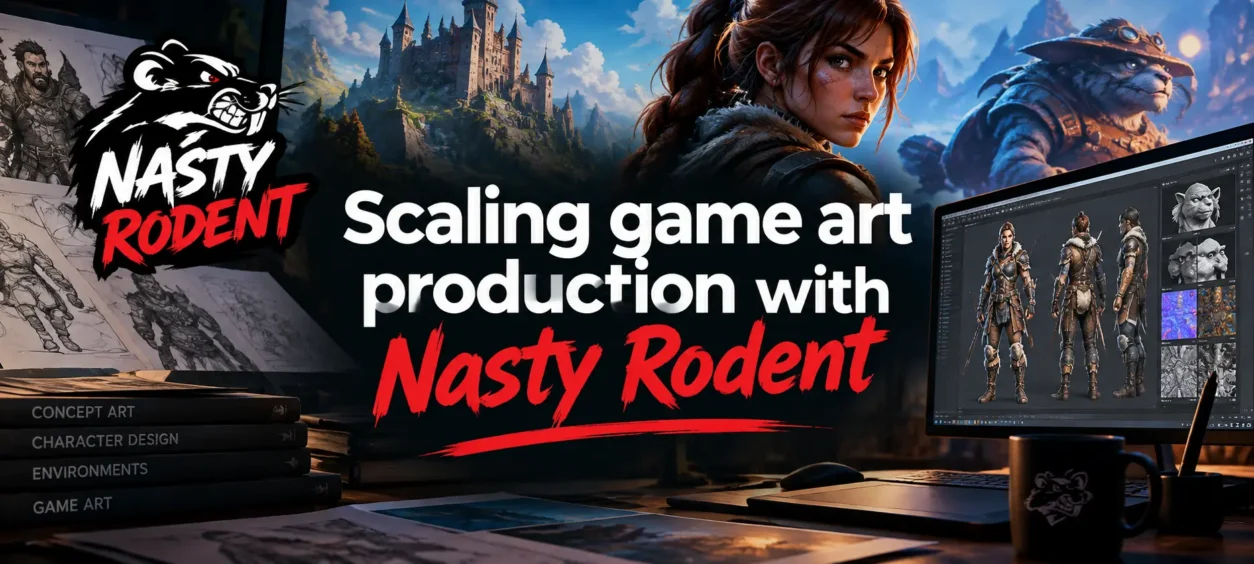
Nasty Rodent steps up to help studios with concept art, 3D assets, and UX/UI design. Our artists plug right in with your internal leads. You can hand off a whole chunk of production-we handle the artist coordination and internal quality checks-but you always keep the final say on the visual style and approvals.
Production support for your core team
Let’s be honest: for an art director or producer, just throwing more artists at a problem usually creates more work. You have to assign tasks, answer endless questions, and make sure everything looks consistent. A properly managed external team takes that burden off your shoulders.
We have managers who handle the daily grind of coordination and communication, while our lead artists run point on execution and quality control. We set up clear checkpoints so your team stays involved in the big decisions, but the day-to-day wrangling of artists stays on our end.
This makes reviews actually useful. Your internal leads just need to decide if the art fits the game’s vibe and what to tackle next, and we handle the messy work of organizing the next iteration.
Real experience on shipped titles
Take Squad, for instance. We teamed up with Offworld Industries to build out military content-everything from concept art and skins to weapons and vehicles. You can check out the published case study to see exactly what we brought to the table.
We also worked on Miasma Chronicles with The Bearded Ladies and 505 Games, building weapons, props, and environment pieces that fit seamlessly into their established visual style.
These shipped projects give you a concrete look at what we do. It makes it much easier to sit down, compare our past work against your references, and figure out exactly what kind of style and production setup your new project needs.
Art services tailored to your project
We cover seven main disciplines. We can jump in for the entire lifecycle of an asset, or just handle specific stages if you already have some of the groundwork done. It’s all about what kind of support you actually need.
3D weapons
Making good weapons is a balancing act between getting the proportions right and knowing how the thing actually feels during gameplay. Whether it’s realistic or sci-fi, a gun needs convincing materials and parts that make sense for animation. If it’s a first-person game, we figure out exactly where the camera sits so we know where to push the highest detail.
3D vehicles
Vehicles are complex beasts that cram exterior modeling, interior details, and moving mechanics into a single asset. Whether you need a civilian car, a military transport, or an aircraft, we plan out the moving parts and damage states right from the start. That way, the model holds up perfectly no matter how players interact with it.
3D characters and creatures
A great character needs the right mix of silhouette, anatomy, clothing, and surface details to match your game’s unique style. We build the topology specifically around how the character will move, keeping rigging and animation needs in mind from day one. Whoever takes the model next gets something that’s actually ready to be rigged.
3D environments
Level designers need reliable building blocks. We create modular architecture, environment assets, and reusable materials that snap together easily thanks to consistent dimensions and connection points. We also pay close attention to visual hierarchy and camera angles so the space is easy to navigate and looks atmospheric.
3D props
Props are what make a world feel lived in. We balance the detail and technical budgets based on what the object actually does-is it just background dressing, or is the player going to pick it up and inspect it? By producing related props in batches, we make sure the whole scene shares a consistent visual language.
Concept art
Our concept artists figure out the visual direction and turn loose ideas into solid references for the 3D team. This might mean silhouette studies, environment layouts, or detailed breakdowns of how a prop is constructed. Nailing these things down early saves everyone a massive headache once 3D production starts.
Game UX and UI
Your interface is the bridge between the game’s art style and the player’s actions. We design navigation flows, screen layouts, HUD elements, and icons that make sense. We always design with the specific platform and input methods in mind, making sure everything is readable and ready for the dev team to implement.
Assets built for your specific pipeline
Technical prep starts by looking closely at your project. Whether you’re in Unreal, Unity, or a custom engine, we sync up on your setup, polygon budgets, and delivery specs before anyone starts modeling.
We agree on scale, UV rules, LODs, and collision bounds. Our internal checks aren’t just about making it look pretty; we make sure it actually works technically. When we hand files over, they’re organized exactly how you asked, with consistent naming and all the source files you need.
It makes integrating the batch a breeze for your team. We also nail down who is doing things like rigging or engine integration, so there’s no confusion later.
Reviews designed to protect the work
We time our progress reviews around the milestones that are painful to change later. For a standard 3D asset, that means you approve the basic proportions before we dive into the crazy details, and you check the topology and UVs before we finalize the textures.
We share progress at set stages and loop your feedback into the next iteration. This keeps your leads in the loop and catches issues early. We bake review times right into the schedule. If feedback drastically changes an already approved design, we talk about the impact on time and budget before moving forward so there are no surprises.
Flexible collaboration
If you have a strict list of deliverables, a defined asset batch works great. But if your priorities are constantly shifting or you’re running a live service game, ongoing team support is usually the better call. Maybe you just need someone to knock out some concepts or finish texturing models you already have.
We adjust the team size and management level based on your scope, and we plan the onboarding and schedule around exactly what your production actually needs right now.
Let’s talk about your next milestone
Starting a conversation is easy-just send over an asset list and a few visual references. Tell us your target platform, the engine you’re using, and when you need it done. Knowing your budget range also helps us figure out a realistic scope. We’ll take a look, ask a few questions, and put together an initial estimate.
Browse the game art portfolio to see what we can do, and send us your brief to get the ball rolling on your next big milestone.