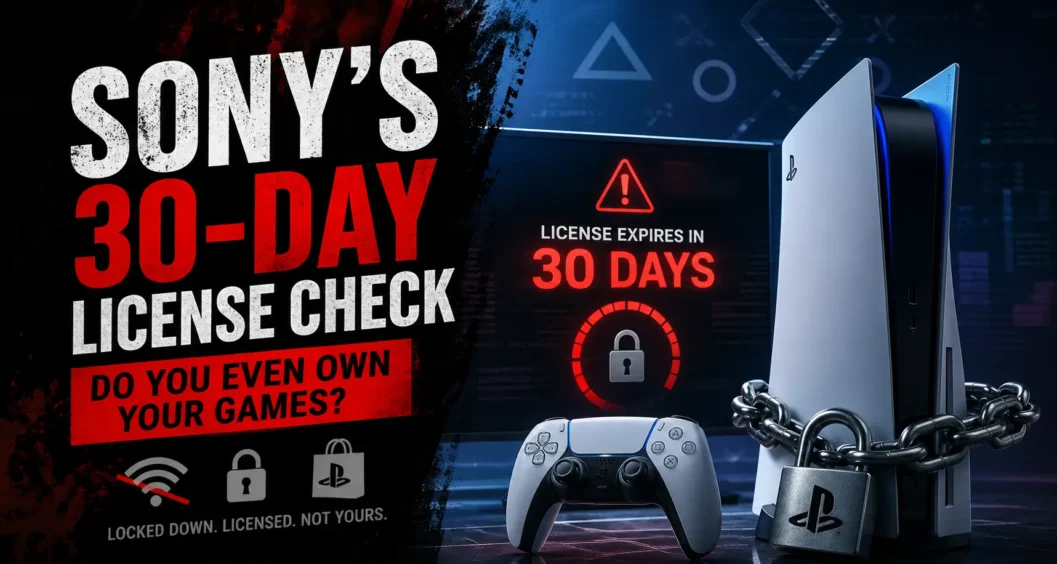
Sony is under the spotlight right now, and for once, it’s not about a blockbuster release or a new console feature. Instead, it’s a growing controversy that’s hitting much closer to home — how much control players really have over the games they’ve paid for.
This reported PS5 license issue, tied to a potential 30-day check-in system, has quickly turned into a wider debate around Sony DRM and what it means for the future of gaming. And the more you look at it, the less it feels like a small technical detail and more like a warning sign.
Because if this is the direction things are heading, then PlayStation digital ownership might not be what players think it is.
The PS5 License Issue That Started It All
The controversy centres around reports that some newly purchased digital titles may require a periodic online check to remain playable. If a console stays offline for too long — roughly around 30 days — the game’s license may need to be revalidated before it can be accessed again.
On the surface, that might not sound like a major problem. Most players are connected most of the time anyway. But that’s not really why this has blown up.
The issue is what it represents.
This isn’t just a background system — it’s a clear example of how Sony DRM can directly affect access to games, even after they’ve been purchased. And once that system exists, it opens the door for tighter restrictions in the future.
PlayStation Digital Ownership Isn’t What It Used to Be
There was a time when buying a game meant exactly that — it was yours. No conditions, no timers, no reliance on external systems to keep it running.
But the shift to digital has slowly changed that. Convenience replaced physical ownership, and most players accepted the trade-off without thinking too much about it.
Now, situations like this are forcing that conversation back into the spotlight.
PlayStation digital ownership doesn’t mean permanent access. It means you have a license, and that license comes with rules. Whether it’s tied to an account, a server, or, now, potentially a timed validation system, the control ultimately sits with the platform holder.
For a lot of players, that’s starting to feel like a very different kind of ownership.
PlayStation Store Control Is Tighter Than Ever
This is where the bigger picture starts to come into focus.
When you buy a digital game on PlayStation, you’re doing it through a single ecosystem. There’s no alternative storefront, no competition within the platform, and no way to move that purchase elsewhere.
This level of PlayStation Store control means Sony dictates pricing, availability, and now potentially how access is maintained over time.
On their own, these systems might seem standard for digital platforms. But when combined with evolving DRM measures, they highlight just how much power sits in one place.
And that’s where players are starting to get uncomfortable.
The Future of Digital Gaming Is Heading One Way
It’s impossible to ignore the direction the industry is moving in.
Digital sales dominate, physical media is slowly fading, and hardware is increasingly designed around online ecosystems. Whether it’s a future PlayStation console or a mid-generation refresh, the push toward digital-only experiences feels inevitable.
That’s why this conversation matters now.
Because the future of digital gaming won’t just be about convenience — it will be defined by how much control platforms retain over access to content.
If systems like this 30-day check become standard, then access to games becomes conditional, not guaranteed.
Why Players Are Pushing Back
The reaction from the community has been strong, and it’s not hard to see why.
This isn’t just about needing an internet connection. It’s about the idea that something you’ve paid for can stop working unless certain conditions are met.
There’s also a layer of history here that hasn’t gone unnoticed. Sony once positioned itself as the player-friendly alternative to restrictive DRM practices, especially during previous console generations.
Now, with concerns around Sony DRM and this PS5 license issue, players are starting to question whether that stance is changing.
Not overnight, but gradually — through systems that feel small individually, but significant when combined.
Final Thoughts
Right now, there’s still a lack of clear communication from Sony about how this system works or whether it’s here to stay. But the reaction alone shows that this isn’t something players are willing to ignore.
Because at its core, this isn’t just about one feature.
It’s about trust.
If PlayStation digital ownership continues to move further away from true ownership and deeper into controlled access, then players will start to rethink what they’re really paying for.
And as the future of digital gaming continues to evolve, that question is only going to become more important.
If you enjoy games and gaming and want more NEWS from the Gaming World Click Here