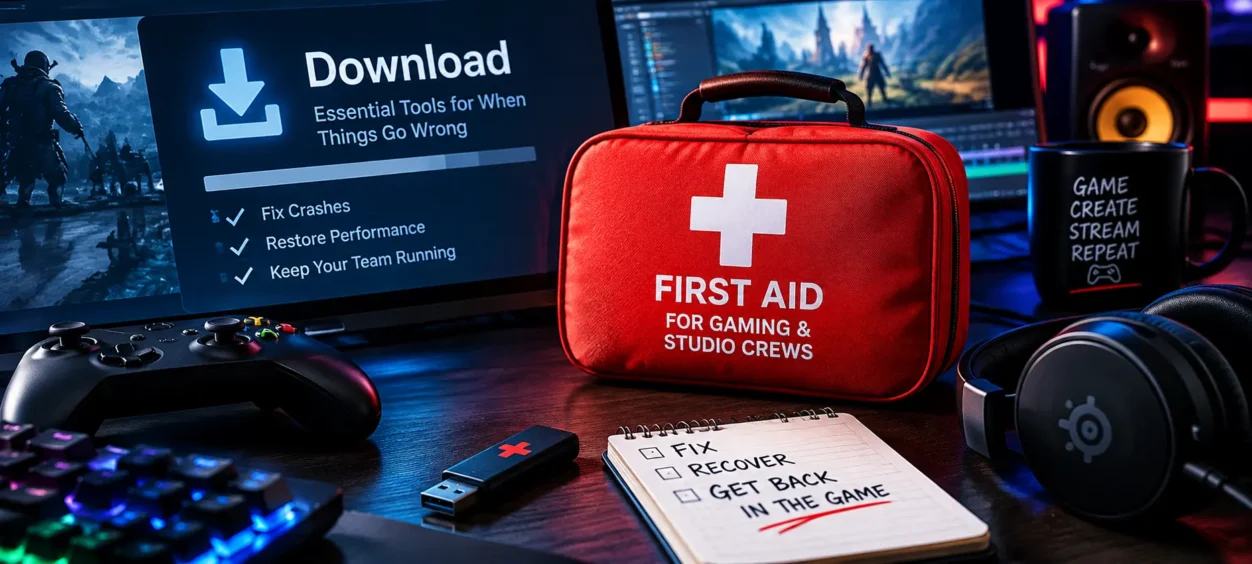
Every gamer knows the feeling of ignoring an update until the worst possible moment. You’re one match from a win, the patch notes pop up, and you click “later.” Most of the time, “later” is fine. But there’s one update you really don’t want to put off, and it doesn’t live on a hard drive. It lives in your crew. When someone at a LAN, in a studio, or in a streamer house suddenly collapses mid-session, nobody’s got time to google what to do. That’s exactly why Coast2Coast First Aid Courses exist, and why the person sitting next to you knowing them might matter more than their aim.
We spend hours thinking about frame rates, ping, and the perfect setup. We spend almost none thinking about what happens when a real emergency drops into the room. Let’s fix that, no lecture, just the stuff that actually helps.
Why Would a Gaming Space Even Need First Aid?
Because sitting still for hours in a crowded, cable-strewn room is harder on the body than it looks. Think about a typical LAN, an esports arena, a studio crunch, or a streamer house on a 12-hour grind. Here’s what’s quietly stacking up.
- Dehydration and skipped meals. Energy drinks aren’t water, and “I’ll eat after this raid” turns into six hours. Low blood sugar and dehydration cause dizziness and fainting.
- Fainting. Standing up fast after hours in a chair, in a hot room full of PCs, drops people more often than you’d think.
- Seizures. Flashing lights, exhaustion, and missed sleep can trigger them, and not everyone who has one knows it’s coming.
- Choking. Snacks, laughing, and a headset mic mid-bite are a bad combo. Choking is silent and fast.
- Trips and electrical hazards. A floor buried in extension cords, power bars, and gear is an ankle-breaker and a shock risk.
- Cardiac arrest. Rare at a young age, but not impossible, and it can strike older crew, parents, or event staff too.
None of this means gaming is dangerous. It means a room full of people is a room full of people, and people need help sometimes.
What Actually Happens When Someone Goes Down?
Panic, usually. A circle forms, phones come out, and everyone waits for someone else to do something. That pause is the dangerous part.
Here’s the simple version every crew should know by heart:
- Check. Is the person responsive? Tap their shoulders, ask loudly if they’re okay. Look for normal breathing.
- Call. If they’re unresponsive and not breathing normally, get someone to call 911 right now and put it on speaker. Send another person for the nearest AED.
- CPR. Start chest compressions in the centre of the chest. Push hard and fast, about 100 to 120 per minute, at least 5 cm deep, and let the chest come all the way back up between pushes. Trained rescuers add rescue breaths at 30:2. If you’re not trained, hands-only compressions still save lives.
- AED. The moment it arrives, turn it on and follow the voice prompts. It literally talks you through it and won’t shock someone who doesn’t need it.
That’s the whole playbook for the scariest scenario. It’s four steps, and anyone can learn them in an afternoon.
Why Does Starting Fast Matter So Much?
Because cardiac arrest is a race against the clock, and the clock is brutal.
The Heart and Stroke Foundation estimates about 60,000 out-of-hospital cardiac arrests happen in Canada each year, and only around 1 in 10 people survive. Doing CPR and using an AED can double someone’s chance of making it. And for every minute that passes without CPR or defibrillation, survival drops by roughly 10 percent.
Translate that to a LAN event in a convention hall. If it takes paramedics eight minutes to find the right room and push through a crowd, those eight minutes belong to the people already there. The crew is the first responder, whether they signed up for it or not.
What Should Every Setup Have Within Reach?
Gear up for safety the same way you’d build a rig: get the essentials first, then worry about the extras. A basic kit covers most of what goes wrong on a long session.
- A stocked first aid kit that everyone can find, not buried under a pile of controllers.
- Water on hand, so hydration isn’t an afterthought during a marathon run.
- Clear floors and cable management, because taped-down cords prevent most trips and cut the shock risk from overloaded power bars.
- A known AED location if your venue has one, with the whole crew able to point to it.
None of this is expensive or complicated. It’s the kind of five-minute prep that saves a night, and it pairs with training to make a real difference when seconds count.
What’s the “First-Aider in the Party” Idea?
Think of it like a raid comp. You wouldn’t run a dungeon with five DPS and no healer. So why run an event, a studio, or a group house with nobody who can handle a medical emergency?
The move is simple: make sure at least one person in every “party” is trained. One per shift in the studio. One per team at the esports event. One in the streamer house who everyone knows to shout for. Ideally more, because the trained person might be the one who’s hurt, or asleep, or on a food run.
It costs almost nothing and changes everything. The trained person isn’t just skills on legs. They’re the one who stays calm, gives orders, and stops the room from freezing up. In a crisis, someone who knows what to do is worth more than any upgrade you can buy.
Aren’t Game Studios and Tech Offices Covered by Workplace Rules?
Yes, and this is where it gets real for anyone working in the industry. Kanata is Ottawa’s west-end tech hub, packed with game studios, software companies, and tech offices. Those are workplaces, and in Ontario, workplaces have first aid duties.
Businesses covered by the WSIB follow Regulation 1101, which sets first aid requirements based on how many workers are on each shift.
- Five or fewer workers on a shift: at least one worker trained in Basic First Aid.
- Six or more workers on a shift: at least one worker trained in Intermediate First Aid.
As of June 2026, Ontario renamed its courses to match the national CSA Z1210:24 standard. Emergency First Aid is now Basic First Aid, and Standard First Aid is now Intermediate First Aid. The thresholds didn’t change, just the names.
Ontario’s Occupational Health and Safety Act also expects employers to take every reasonable precaution to protect workers, and a team with WSIB-compliant certificates helps meet that duty. If a studio runs a late-night crunch or hosts a public tournament, having trained people on the floor isn’t just smart, it’s part of doing the job right.
How Hard Is It to Actually Get Trained?
Easier than most people expect. You’re not signing up for medical school. Modern courses use blended learning, which means you do the theory online at your own pace, then show up for one short hands-on session to practise compressions, AED use, and clearing an airway on a dummy.
You walk out knowing the four steps cold, with a certificate that’s valid for three years. For a studio or an event organiser, booking a group session means your whole crew trains together and learns exactly who does what. If you want to sort it for your team or your community, it’s worth checking out Coast2Coast First Aid trainings and picking a date that works around your schedule.
The Patch Nobody Regrets Installing
Here’s the thing about this particular download. You install it, and you hope you never need it. Most of the time, you won’t. But the one time you do, it’s the difference between a scary story with a good ending and one nobody wants to tell.
So treat it like the most important update of the year. Get one person in every party trained. Know where the nearest AED is. Learn the four steps. Then get back to the game, knowing that if the worst happens, your crew won’t freeze, they’ll act.
If you are looking for first aid and CPR training near the Robertson Road and Merivale Road corridor, or the Bells Corners area of Ottawa’s west end, or surrounding areas, you may reach out to Coast2Coast First Aid & Aquatics in that area.
Frequently Asked Questions
Q: Is cardiac arrest really a risk for young, healthy gamers?
A: It’s rare at a young age but not impossible, and gaming spaces also include older crew, event staff, and parents. The Heart and Stroke Foundation estimates about 60,000 out-of-hospital cardiac arrests happen in Canada each year, so a prepared crew matters at any event with people in the room.
Q: What are the first steps if someone collapses at a LAN or in a studio?
A: Check if they’re responsive and breathing normally. If not, have someone call 911 and send another person for the nearest AED. Start chest compressions right away, and use the AED as soon as it arrives by following its voice prompts.
Q: Do I need to be trained to do CPR, or can I just try?
A: If you’re untrained, hands-only CPR still saves lives, so don’t hesitate to push hard and fast on the centre of the chest. That said, a short course teaches you proper depth, rate, and AED use, which makes you far more effective and far less likely to freeze.
Q: Are game studios in Kanata legally required to have first aiders?
A: Ontario workplaces covered by the WSIB follow Regulation 1101, which requires at least one worker trained in Basic First Aid on a shift of five or fewer, and Intermediate First Aid on a shift of six or more. Game studios and tech offices are workplaces, so these rules apply.
Q: How long does first aid training take and how long is it valid?
A: With blended learning, you do the theory online at your own pace and finish with one short in-person skills session. The resulting certificate is valid for three years, and group bookings let a whole studio or event crew train together.