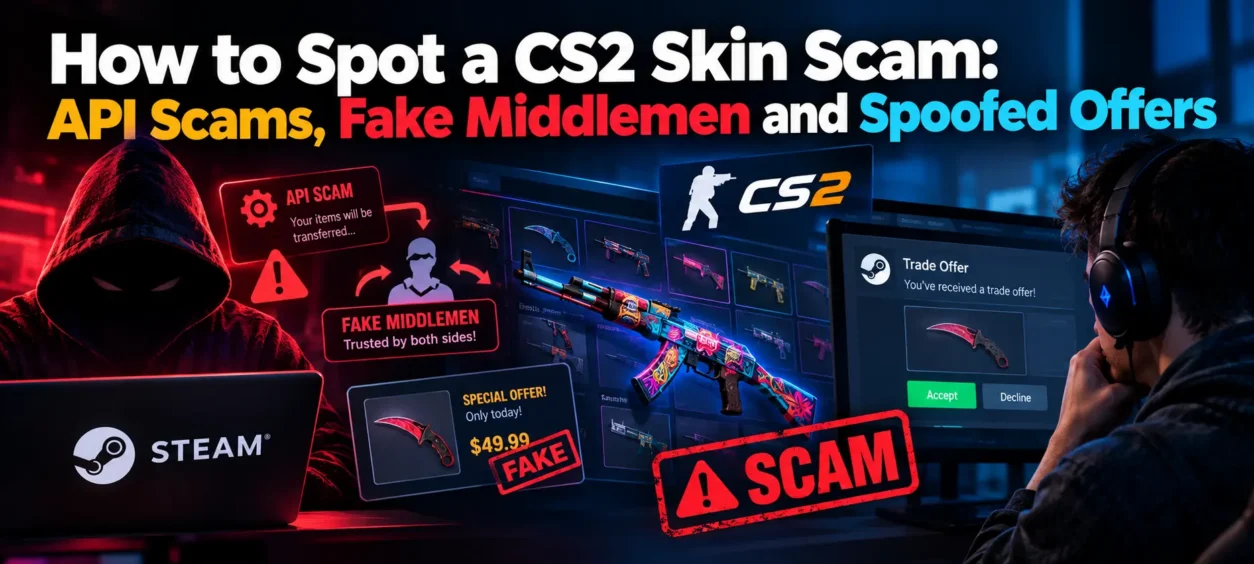
Skin scams in CS2 have moved well beyond the clumsy “send first and I’ll send back” attempts of a decade ago. The people running them now build convincing websites, impersonate known traders and exploit parts of Steam most players have never looked at. Losing an inventory takes seconds and Steam Support will not restore it.
Here are the three methods responsible for most losses, and the checks that stop all of them.
The API Key Scam
This is the most damaging and the least understood. A Steam API key lets an application read and act on your account’s trade offers. If an attacker obtains one for your account, they can cancel a legitimate trade you have just confirmed and instantly replace it with an identical-looking offer sent from an account they control.
You confirm on your phone, see the right items and the right avatar, and send your skins to a stranger. Nothing about the confirmation screen looks wrong, because technically nothing is.
How they get the key
Almost always through a fake Steam login page. A site offers a giveaway, a free case, a trade-bot service or a vote for a friend’s team, then presents a Steam login prompt that is a rendered copy rather than the real thing. Once you enter credentials there, the key is generated behind the scenes.
The check
Go to your Steam API key page directly and look at it. If a key exists and you did not create it, revoke it immediately, then change your password and deauthorise all devices. Do this now rather than when something goes wrong, because a key can sit dormant for months before it is used.
Fake Middlemen
In high-value trades, one party sometimes suggests using a trusted third party to hold items. The scam is that the middleman is an accomplice with a cloned profile: same avatar, same display name, a name history edited to match, and a profile filled with fabricated positive comments.
The real giveaway is the Steam ID. Display names can be copied exactly, but the numeric ID behind the account cannot. Check it against whatever source recommended that middleman in the first place, and check it yourself rather than clicking a link the other party provided.
The better answer is simply not to use middlemen. Legitimate high-value trades run through established marketplaces with escrow, and the marginal saving from going private is rarely worth the exposure.
Spoofed Trade Offers
The simplest version still works because people are in a hurry. An offer arrives containing an item that looks like the one agreed but is not: a different wear condition, a StatTrak variant swapped for a plain one, or a skin with a visually similar name from an entirely different collection.
Souvenir and normal versions of the same finish are a favourite, because the thumbnails are nearly identical and the values are not.
Read the item names in the offer itself, not the chat. Check wear and float. If anything has changed since you agreed, decline and start again.
The Checks That Cover All Three
Enable Steam Guard Mobile Authenticator and leave it on. Never log in to Steam anywhere except steamcommunity.com, typed by you. Confirm the domain before you enter anything. Treat unsolicited trade offers as hostile by default. Verify identities by Steam ID rather than display name.
And be realistic about where risk actually sits. Peer-to-peer trading with strangers is where almost all inventory losses happen. Using an established marketplace, or a platform such as CSGO Gem, removes the counterparty from the equation entirely, which is a different risk profile rather than no risk at all — you are trading the chance of being scammed for a platform’s fees and terms. Understand what you are paying for and decide accordingly.
If you are hit, revoke your API key, change your password, deauthorise devices and report the offending account. Then accept that the items are gone. Recovery is vanishingly rare and anyone promising to get them back for a fee is running the second scam of the day on you.
If you enjoy games and gaming and want more NEWS from the Gaming World Click Here