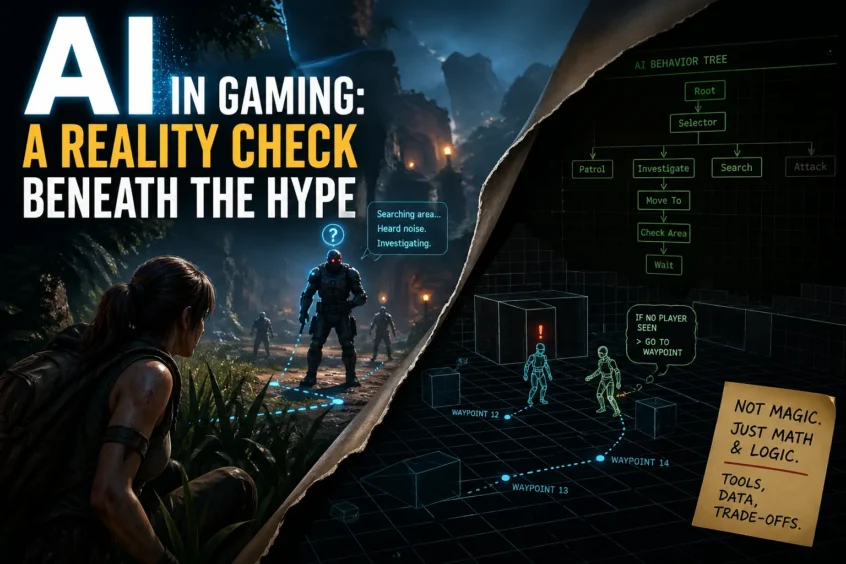
Artificial intelligence continues to dominate conversation across the games industry. From automated testing tools to AI-assisted art and narrative generation, it’s often framed as the next major leap forward. The expectation is clear: faster development cycles, reduced costs, and entirely new creative possibilities.
But insights from Keywords Studios suggest the reality is more measured.
After evaluating around 500 AI tools internally, Jon Gibson, Head of Transformation at Keywords Studios, found that only a small number are delivering meaningful value in real production environments. For an industry that thrives on innovation, that’s a sobering conclusion—one that highlights a widening gap between promise and practice.
Too Many Tools, Not Enough Direction
One of the most immediate challenges isn’t a lack of innovation—it’s the opposite. The market is now saturated with AI solutions, each promising to streamline workflows or unlock new efficiencies.
Yet testing hundreds of tools only to adopt a select few reveals a deeper issue: a lack of clear direction.
Studios are experimenting, but often without a defined framework for evaluation or implementation. This creates a cycle where teams trial tools out of curiosity rather than necessity, leading to fragmented workflows and limited long-term impact.
Instead of accelerating production, this abundance can slow teams down. Decision-making becomes harder, integration becomes more complex, and the signal-to-noise ratio continues to worsen.
The Missing Link: Real-World Application
AI tools frequently shine in controlled demonstrations. They generate high-quality outputs, perform specific tasks quickly, and showcase what’s technically possible.
But real-world game development is far less predictable.
Pipelines are complex, collaborative, and constantly evolving. Tools need to function reliably across different teams, integrate with existing systems, and handle edge cases that rarely appear in demos.
‘Everyone’s focusing on building better AI, and no-one’s really focusing on how to use it in a live production environment,’ Gibson told The Game Business.
This disconnect between technical capability and practical usability is one of the biggest barriers to meaningful adoption. It’s not that the technology isn’t impressive; it’s that it often isn’t production-ready.
From Innovation to “Chaos Phase”
Gibson characterises the current state of AI as early and unstructured:
‘AI feels like it’s in the chaos phase right now. And we need to move to the usable phase. How do we use AI in live production environments? How do we use AI in a way where it complements teams rather than potentially threatens teams? And also how do we use it in a context where it’s governed, it’s controlled, it’s IP safe, it’s legally safe, it’s ethically and morally safe?’
This idea of a “chaos phase” reflects an industry still experimenting, still searching for best practices, and still grappling with the implications of the technology.
The next phase isn’t about more powerful models—it’s about structure. Governance, reliability, and ethical considerations are becoming just as important as raw capability.
When “Impressive” Doesn’t Mean Useful
There’s a critical distinction between what looks impressive and what proves useful over time.
In isolation, many AI tools can deliver striking results. They can generate assets, assist with coding, or automate repetitive tasks. But in a production environment, consistency matters more than novelty.
Developers need tools that are reliable under pressure, easy to integrate into existing pipelines, and predictable in their outputs. Even small inconsistencies can create bottlenecks or require additional oversight, reducing any efficiency gains.
This is where many tools fall short. They demonstrate potential, but struggle to meet the practical demands of day-to-day development.
Chasing Cool Instead of Solving Problems
Another recurring issue is the industry’s tendency to prioritise novelty over necessity.
‘A lot of people focus on what’s cool. They focus on the tool itself or the model itself, rather than what they’re trying to do.
‘A company will use a tool or build a tool without a specific use case and try to cram it into their production pipelines, rather than flipping that problem around and saying: “What are our pain points? What are we trying to solve?” And then building a tool against that.’
This approach often leads to misalignment. Instead of solving real problems, teams adapt their workflows to fit the tool; an inversion that rarely produces efficient results.
The more effective path is the opposite: identify clear challenges first, then apply AI in a targeted, purposeful way.
Growing Concerns Across the Industry
As AI becomes more visible, concern among developers is rising alongside it.
‘That statistic of 52% of developers being concerned about the usage of AI, that’s gone up every year for the last three years,’ Gibson said.
‘As AI tools and AI models and AI technology has become more prevalent, the lack of understanding and the concern has increased.’
These concerns are not purely technical—they’re cultural and professional. Questions around job security, creative ownership, and the long-term role of human developers are becoming harder to ignore.
When new technology is introduced without clear communication or guidelines, uncertainty is inevitable. And in a creative industry, that uncertainty can directly impact morale and trust.
A More Measured Path Forward
Importantly, Gibson’s perspective isn’t anti-AI—it’s grounded in practical application.
‘Until we’re able to work out how to meaningfully build this technology into production pipelines in a way that is safe, in a way that adds value, in a way that complements the talent that already exists in this industry, and doesn’t threaten that talent, I think there’s always going to be that level of concern.’
This points to a more balanced approach: one where AI supports developers rather than replacing them, and where implementation is guided by clear principles rather than experimentation alone.
The Road Ahead
AI will continue to play a significant role in the future of game development. The technology is advancing rapidly, and its potential remains substantial.
But progress will depend less on breakthroughs and more on integration.
The tools that succeed will be those that align with real workflows, address genuine problems, and operate within clear ethical and legal boundaries. Until then, being cautious isn’t a barrier; it’s a necessary filter.
It forces the industry to slow down, ask better questions, and ensure that innovation delivers meaningful, lasting value for both developers and players alike.
If you enjoy games and gaming and want more NEWS from the Gaming World Click Here