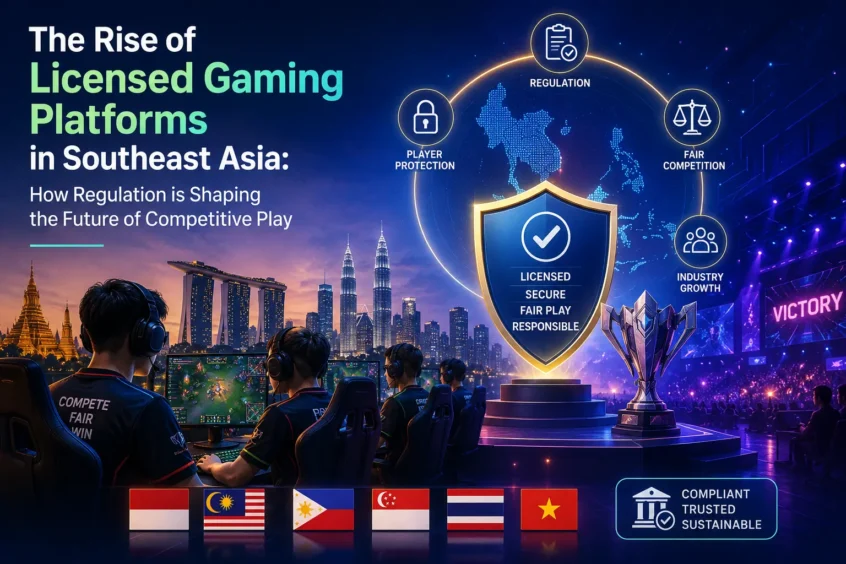
Southeast Asia has quietly become one of the most exciting regions in the global online gaming landscape. From mobile-first gaming communities in Manila to competitive esports arenas in Kuala Lumpur, the market has exploded driven by affordable smartphones, expanding mobile data networks, and a young, digitally fluent population hungry for more. But alongside the surge in player numbers, something equally significant has been happening behind the scenes: the steady rise of regulated, government-licensed gaming platforms that are changing what players can expect from the services they use.
For years, the words ‘regulation’ and ‘gaming’ did not sit comfortably together in the same sentence. The community tended to associate oversight with restriction blocked content, limited access, bureaucratic interference. But a new generation of licensed platforms in Southeast Asia is rewriting that story, demonstrating that a properly regulated environment can actually be the foundation for better, fairer, and more sustainable competitive play.
Why Southeast Asia? Why Now?
The numbers tell part of the story. Southeast Asia is home to over 250 million online gamers across the Philippines, Indonesia, Vietnam, Thailand, and beyond a figure that has grown dramatically over the past five years. The region has a median age well below that of Europe or North America, and smartphone penetration has brought online gaming to communities that previously had no access to it.
The Philippines has emerged as a particularly compelling case study. With one of the highest social media usage rates in the world and a gaming culture that spans everything from mobile titles to competitive esports, Filipino players are sophisticated, engaged, and increasingly discerning about the platforms they choose. That discernment is creating demand for operators who can offer something beyond flashy promotions platforms that are built on genuine accountability and long-term commitment to their player base.
What Licensing Actually Means for Players
The practical difference between a licensed and unlicensed gaming platform might not be immediately obvious from the outside. Both may offer similar game libraries and sign-up incentives. But the differences run deep, and they matter most over time.
Licensed platforms are required to use certified, independently audited game systems meaning outcomes are determined by genuine fairness, not manipulation. They must implement player protection tools including spending controls and self-exclusion options. They are bound by data security standards that protect personal and financial information. And crucially, they cannot simply disappear overnight without regulatory consequence. For competitive players who care about the integrity of outcomes and the stability of the platforms they invest their time in, these guarantees are not small print they are the whole point.
Unlicensed platforms carry none of these obligations. They can cut corners on fairness, mishandle player data, and vanish without notice. In a market as fast-moving as Southeast Asian online gaming, the difference between building on solid foundations and building on sand has never been more apparent.
The PAGCOR Framework and What It Represents
Central to the Philippine story is the Philippine Amusement and Gaming Corporation PAGCOR a government body responsible for overseeing and licensing gaming operations in the country. PAGCOR does not simply police the industry from a distance. It sets active standards that licensed operators must meet, covering everything from technical integrity and financial compliance to responsible gaming practices and local investment requirements.
Platforms operating within this framework, such as Arena Plus pagcor casino, represent a new standard of operator in the region one that functions transparently within a defined regulatory structure and is accountable to enforceable rules. For players, this means engaging with a platform that cannot afford to cut corners, because the consequences of doing so are real and significant. That is a fundamentally different proposition from the unregulated alternatives that dominated the early years of Southeast Asian online gaming.
The PAGCOR model is also attracting attention from policymakers across the wider region. Indonesia, Vietnam, and Thailand are all at various stages of developing their own regulatory approaches to digital gaming, and the Philippine experience is providing a valuable reference point for how to build a credible, player-focused framework without stifling growth or innovation.
Communities Built to Last
There is a bigger picture here too. The best gaming platforms have always been more than just products they are communities. And communities need stability to thrive. The platforms that players return to year after year are the ones that invest in the social fabric of gaming: leaderboards, live events, forums, tournaments, and the kind of ongoing content that keeps a community engaged long after the initial excitement of signing up has faded.
Licensed operators, anchored by long-term regulatory commitments, have both the foundation and the incentive to make those investments. When a platform knows it cannot disappear without consequence, it is far more likely to think in years rather than months to build real communities rather than chase short-term acquisition numbers.
As Southeast Asian gaming continues its remarkable growth, the platforms that will define the next decade are not necessarily the loudest or most aggressively marketed. They are the ones that have done the harder work of building legitimate, accountable operations within a proper regulatory framework. For players who take their gaming seriously who care about where they invest their time, their competitive energy, and their loyalty licensing has become one of the most meaningful quality signals available. In a crowded market, it is the difference that matters.