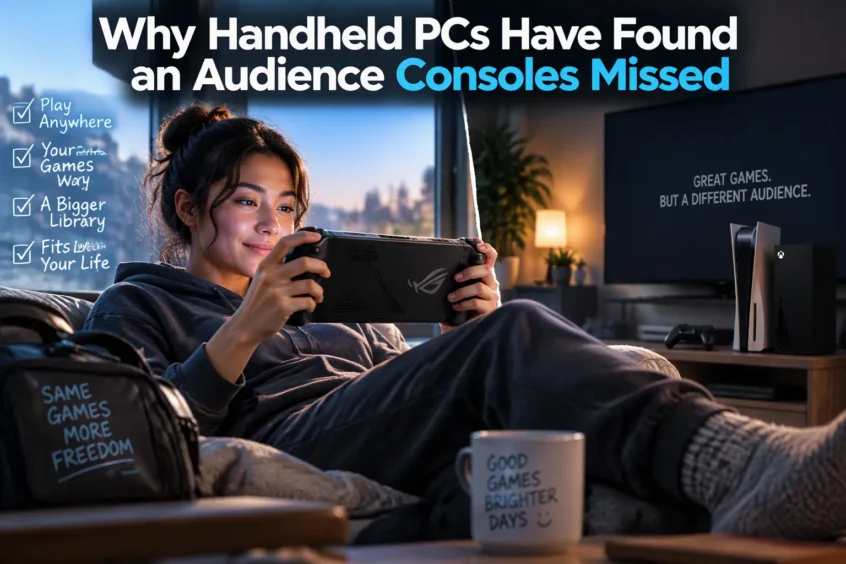
A few years ago the idea of a handheld gaming PC was a niche curiosity for enthusiasts willing to tinker. Today it is one of the fastest-growing corners of the hardware market, and it has reached players that traditional consoles never quite served. The reasons are partly technical and partly about how people actually play.
The handheld PC did not win by beating consoles at their own game. It won by offering something different enough to matter.
The library is the killer feature
The single biggest draw is access to an existing PC game library. Players who have spent years accumulating games on digital storefronts can suddenly carry all of it in their hands, with no need to rebuy anything. That is a proposition no console has ever offered.
It also sidesteps the walled-garden problem. A handheld PC runs the same storefronts, the same sales and the same back catalogue as a desktop, which means the value proposition grows the longer someone has been a PC gamer.
Flexibility consoles cannot match
Because it is a PC underneath, the device does what a PC does. Players can install different storefronts, tweak settings, run emulators, and treat it as a small computer rather than a locked appliance.
That openness appeals to exactly the audience consoles have historically underserved: people who want control over their hardware and are comfortable adjusting it to taste.
The trade-offs are real
None of this is free. Handheld PCs run hotter, their battery life is shorter than a dedicated console handheld, and performance requires settings compromises that a console hides from the player. Getting a demanding game running smoothly can involve fiddling that a console owner never faces.
For some that tinkering is part of the appeal. For others it is a barrier, and it is the main reason the category remains broader than it is universal.
Why the timing worked
The hardware finally became good enough. Efficient mobile chips reached a point where respectable performance in a battery-powered device was realistic, and that technical threshold is what turned a long-standing idea into a viable product.
Once one device proved the demand existed, competitors followed, and the resulting competition has driven both quality and variety upward quickly.
A device that fits modern play
The deeper reason is that handheld PCs match how people game now, in shorter sessions, across multiple places, around the edges of a busy day. Some owners even use the built-in browser to keep up with other online services between sessions, from storefront sales to logging in to a hititbet resmi sitesi ve üyelik işlemleri account, which underlines how these devices function as small general-purpose computers rather than single-purpose game machines.
That versatility is the whole point. The handheld PC is not trying to be the best gaming machine in the house. It is trying to be the one you actually reach for.
Where it goes next
Expect the category to keep growing as chips improve and software gets better at managing the compromises. The handheld PC has already proved there was an audience consoles left on the table. The only question now is how large it becomes.
Want more news from the Tech world for Gaming Peripherals to Hardware Click Here