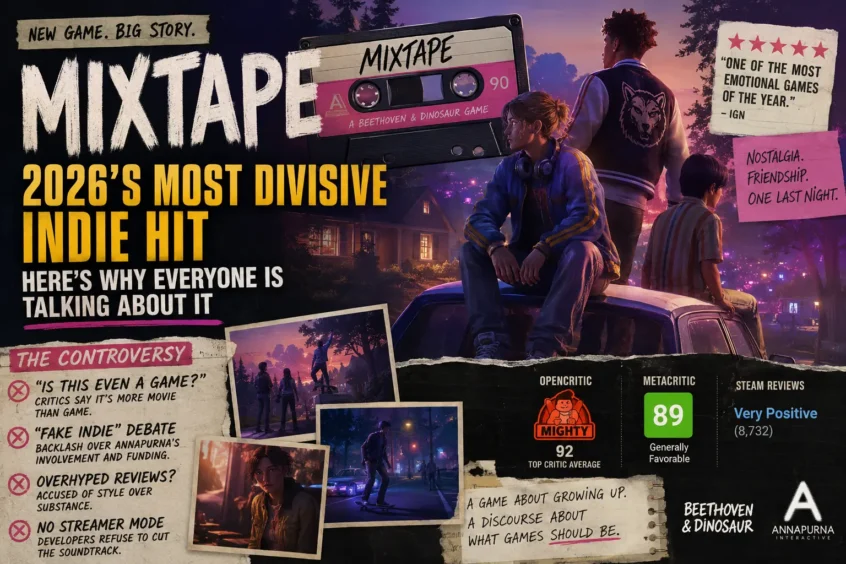
When Mixtape launched earlier this month, it looked like another stylish indie darling destined to quietly collect awards and emotional reactions from players. Instead, the latest game from Beethoven & Dinosaur and publisher Annapurna Interactive has exploded into one of the most talked-about — and controversial — releases of 2026.
On the surface, Mixtape is a nostalgic coming-of-age adventure inspired by 90s teen culture, music videos, and classic films. But within days of release, discussions online shifted away from the game’s emotional storytelling and toward accusations of “fake indie” marketing, culture war debates, review score arguments, and complaints over its lack of traditional gameplay.
The result? A game that has become just as famous for the discourse surrounding it as the experience itself.
What Is Mixtape?
Developed by Beethoven & Dinosaur and published by Annapurna Interactive, Mixtape released on May 7, 2026 for PlayStation 5, Xbox Series X|S, Nintendo Switch 2, and PC.
The game follows three teenage friends during their final night together before adulthood sends them in different directions. Throughout the experience, players move through stylised memories accompanied by a licensed soundtrack featuring artists like Devo, The Smashing Pumpkins, Joy Division, and The Cure.
Critics largely praised the title for its emotional storytelling, soundtrack, and presentation. Some outlets even called it one of the highest-rated games of the year.
But that praise quickly triggered backlash online.
The “Is This Even a Game?” Debate
The biggest criticism aimed at Mixtape revolves around gameplay — or what some players argue is the lack of it.
Much of the experience consists of cinematic sequences, dialogue, music-driven moments, and light interaction rather than traditional mechanics. While there are skateboarding sections, mini-games, and exploration segments, critics of the game say it often feels more like an interactive movie than a full video game.
On Reddit and social media, some players questioned whether the glowing review scores matched the actual experience. Others described it as “style over substance,” arguing that the soundtrack and visuals carry an otherwise shallow experience.
This isn’t a new argument in gaming. Narrative-heavy titles like Life is Strange, Firewatch, and Gone Home faced similar criticism in previous years. But Mixtape arrived at a time when online gaming discussions are already heavily polarised, making the backlash much louder.
At the same time, supporters argue that Mixtape succeeds precisely because it focuses on emotion and atmosphere instead of combat systems or complex mechanics.
For many players, the game’s short runtime and cinematic presentation are part of its charm.
The “Fake Indie” Controversy
Another major talking point has been the game’s connection to Annapurna Interactive.
Online critics began labelling Mixtape a “fake indie” game due to Annapurna’s financial backing and its links to billionaire businessman Larry Ellison through Annapurna founder Megan Ellison. Discussions quickly spiralled into claims that the game had an unfair marketing advantage compared to smaller indie projects.
Supporters pushed back against this narrative, pointing out that Beethoven & Dinosaur itself is still an independent Australian studio and that Annapurna has published beloved indie titles for years, including Outer Wilds and Stray.
Still, the debate highlights a growing tension within the indie gaming space. As development costs rise and publishers become more involved, players increasingly question what truly qualifies as “indie.”
Review Scores Sparked More Drama
The review scores surrounding Mixtape only intensified the arguments.
The game launched with extremely strong critic ratings, including high scores from major outlets and impressive averages on OpenCritic and Metacritic.
Meanwhile, Steam user reviews remained “Very Positive,” with thousands of players recommending the game.
However, some online users accused critics of overhyping the game due to its artistic presentation and soundtrack. Others claimed the praise felt “forced,” particularly because the gameplay itself was fairly limited.
This led to another familiar gaming industry debate: should emotional storytelling and artistic direction be valued equally alongside gameplay systems?
For some players, Mixtape represents gaming as art.
For others, it represents critics rewarding style over interactivity.
Nostalgia Became a Dividing Line
One reason Mixtape connects so strongly with some players — and completely misses others — is its heavy reliance on nostalgia.
The game draws obvious inspiration from 80s and 90s coming-of-age films, with reviewers comparing it to the work of John Hughes.
For players who grew up during that era, the soundtrack, awkward friendships, late-night adventures, and suburban atmosphere hit hard emotionally.
Others found the nostalgia overly manufactured.
Some online comments criticised the game’s depiction of youth culture as unrealistic or overly Hollywood-inspired. Others argued the game presents a very narrow version of teenage life focused primarily on white suburban America.
That divide has become central to the game’s reception. Players who emotionally connect with its themes often adore it, while those who do not tend to see it as shallow nostalgia bait.
The Streamer Mode Problem
One smaller but surprisingly heated controversy involved streaming.
Because Mixtape relies heavily on licensed music, many players expected a “Streamer Mode” option that would replace copyrighted songs during livestreams. Instead, the developers confirmed the game would not include one because changing the soundtrack would compromise the experience.
While some respected the artistic decision, others criticised it for making the game difficult to stream safely on platforms like Twitch and YouTube.
In today’s gaming industry, where streamers heavily influence public perception and sales, that decision felt risky.
Why Mixtape Still Matters
Despite the controversy, Mixtape has undeniably become one of 2026’s standout indie releases.
The game’s soundtrack, presentation, and emotional storytelling clearly resonated with a huge audience, even if the gameplay itself remains divisive. More importantly, the reaction to Mixtape reveals how fragmented gaming culture has become.
A short narrative adventure about friendship somehow evolved into arguments about review integrity, indie authenticity, nostalgia, streaming culture, and what people even consider a “real game.”
And perhaps that’s why Mixtape matters.
Not because everyone agrees it’s a masterpiece — but because almost nobody agrees on what it actually is.
If you enjoy games and gaming and want more NEWS from the Gaming World Click Here