
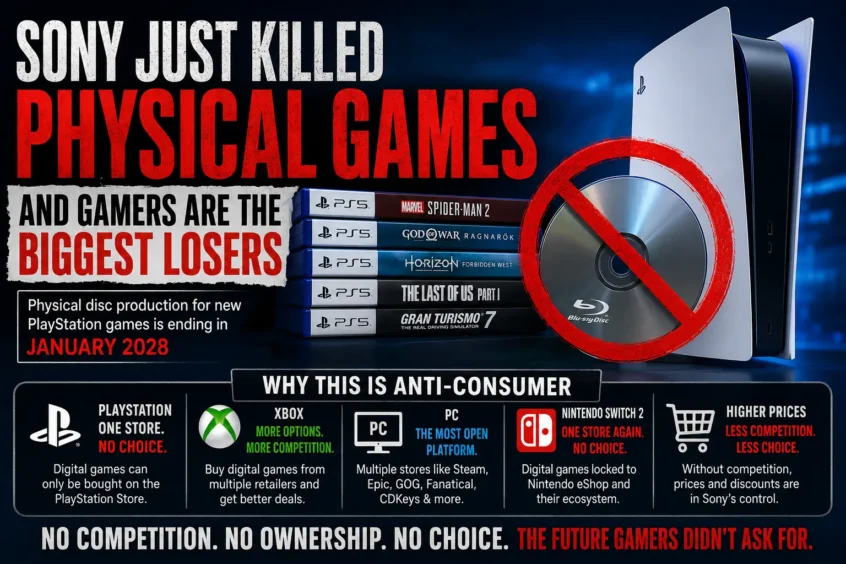
Sony has confirmed that physical disc production for new PlayStation games will be phased out, with full transition expected by January 2028. While this shift has been building for years, the confirmation marks one of the most significant structural changes in modern console gaming history.
This move raises important questions about ownership, competition, pricing control, and consumer choice. While digital distribution is now the dominant format, the removal of physical media altogether reshapes how players buy, access, and potentially even “own” their games.
This article breaks down what Sony’s decision means, how it compares to Xbox, PC and Nintendo’s ecosystems, and why many gamers see this as a step toward a more closed digital marketplace.
Sony Confirms the End of Physical Game Production
Sony’s announcement outlines a gradual wind-down of physical disc production for new PlayStation titles, with January 2028 set as the key milestone where new releases will no longer receive physical retail versions.
Importantly, this does not mean existing physical games will disappear. PS4 and PS5 disc libraries will continue to function, and retailers may still sell remaining stock. However, the pipeline for new physical releases will effectively close.
In practical terms, this means future PlayStation games will be digital-first — and eventually digital-only.
This aligns with a wider industry trend already visible in gaming, where digital sales now dominate revenue across most major publishers.
The Core Issue: One Storefront, One Controller
One of the most debated aspects of PlayStation’s digital ecosystem is its structure. Unlike PC gaming, and unlike parts of the Xbox ecosystem, PlayStation digital games are almost exclusively sold through a single marketplace: the PlayStation Store.
This means:
- Prices are largely controlled by one platform holder
- There is limited competition between retailers for digital PS5/PS6 games
- Discount cycles are dictated centrally rather than competitively
On PC, players can often purchase legitimate game keys through multiple authorised storefronts such as major retailers and key sellers, creating price competition and frequent discounts.
On Xbox, while Microsoft’s ecosystem has tightened over time, consumers still frequently see broader third-party key distribution and subscription-based alternatives that affect pricing dynamics differently.
PlayStation, by contrast, operates a more closed system where the majority of digital purchases flow through a single controlled store.
Why This Matters for Consumers
The central concern raised by critics is not digital gaming itself, but the lack of marketplace competition.
In a competitive retail environment, multiple sellers push prices down. Physical retail historically played that role for console games — supermarkets, online retailers, and independent stores often competed on price.
As physical media disappears, that external pressure weakens.
With digital storefronts, pricing power is concentrated. That creates a system where discounts exist, but are ultimately controlled by the platform holder rather than competitive market forces.
This is where the debate becomes more than preference — it becomes about market structure.
The Shift Away From Ownership
Another major concern tied to the move away from physical discs is the concept of ownership.
With physical media, consumers historically owned a tangible copy of a game. It could be resold, lent, traded, or kept indefinitely without reliance on online licensing servers.
Digital purchases operate differently. In most cases, users are purchasing a licence to access a game, tied to an account and governed by platform terms of service.
While this model offers convenience — instant downloads, cloud saves, no disc swapping — it also raises questions about long-term access and preservation.
If a platform removes a game from sale or alters licensing terms, consumer access can be affected in ways that physical ownership never allowed.
Xbox Isn’t Perfect – But It Gives Consumers More Ways to Buy
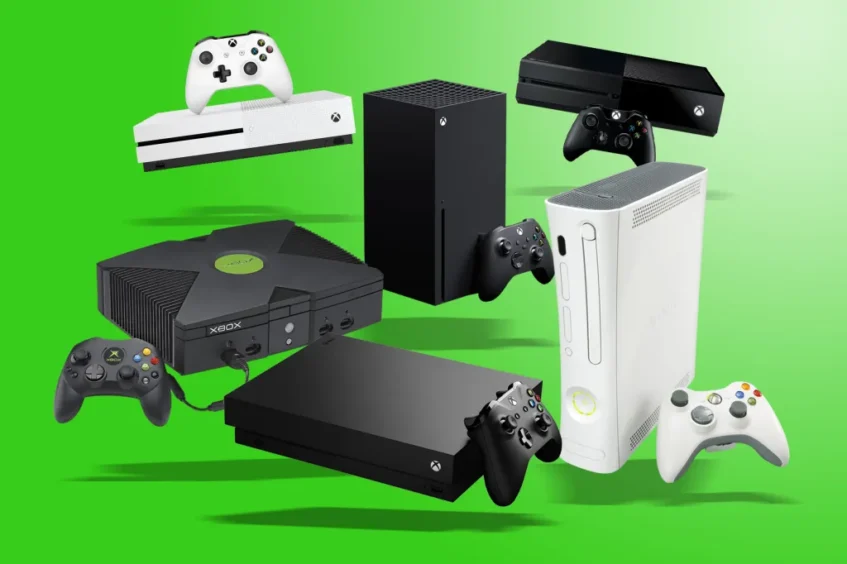
One of the biggest comparisons that will inevitably be made following Sony’s announcement is with Microsoft’s Xbox ecosystem. While Xbox is also embracing a digital future, there are important differences in how consumers can purchase and access games.
Unlike PlayStation, Xbox players can often buy legitimate digital game codes from a variety of retailers. Major online stores regularly sell Xbox digital games and gift codes at discounted prices, while authorised retailers compete throughout the year with sales that often undercut Microsoft’s own storefront.
This competition benefits consumers. If one retailer is charging full price, another may offer a discount. During major sales events, players frequently have several purchasing options rather than relying on a single digital marketplace.
Xbox players also benefit from Microsoft’s wider ecosystem. Many first-party games launch on Xbox Game Pass, giving subscribers access to new releases without purchasing them individually. While Game Pass is a subscription rather than ownership, it provides another option for accessing games without being locked into a single purchasing route.
That doesn’t mean Xbox is an entirely open platform. Microsoft still controls the Xbox ecosystem and its certification process. However, consumers generally have more flexibility when deciding where to spend their money, something that becomes increasingly important as physical media disappears.
PC Gaming Shows What Competition Looks Like
If there’s one platform that demonstrates the benefits of competition, it’s PC.
A PC player wanting to buy a newly released game has numerous legitimate options. Steam may be the largest storefront, but it isn’t the only one.
Players can often choose between multiple authorised retailers and storefronts, including Green Man Gaming, Fanatical, Humble, Epic Games Store, GOG, Amazon and other digital retailers depending on the publisher.
This creates genuine competition.
One retailer may offer a launch discount. Another may bundle bonus content. Another might include loyalty rewards or cashback offers. Consumers can compare prices before deciding where to buy.
Competition like this helps keep prices in check.
Even years after release, PC gamers often see dramatically different prices across multiple stores. Sales happen independently, retailers compete with one another, and publishers frequently work with different partners to reach customers.
It’s not a perfect market, but it is unquestionably a more competitive one.
That level of choice simply doesn’t exist for PlayStation digital software.

Nintendo Is Heading Down a Similar Road
Sony isn’t alone in moving towards a digital-first future.
Nintendo has also continued strengthening its own digital ecosystem with the launch of Switch 2. While physical games remain available today, digital purchases for Nintendo’s platform largely revolve around the Nintendo eShop, with downloadable software generally being redeemed through Nintendo-issued codes or eShop credit sold by retailers.
As with PlayStation, there is limited price competition between competing digital game sellers.
Retailers may discount eShop gift cards or sell download codes where available, but consumers are still ultimately purchasing within Nintendo’s own ecosystem.
The result is another closed marketplace where the platform holder maintains significant control over pricing, promotions and distribution.
If Sony and Nintendo continue moving further towards digital-only futures while maintaining tightly controlled storefronts, millions of console players could find themselves with fewer purchasing options than ever before.
What Happens When Physical Games Disappear?
For decades, physical games acted as a natural competitor to digital storefronts.
If one retailer charged £69.99, another might sell the same game for £59.99.
Supermarkets frequently discounted major releases to attract shoppers. Independent game stores competed with national chains. Online retailers battled for customers through flash sales and promotional offers.
Consumers benefited because retailers had to compete.
Without physical copies, that competitive pressure weakens considerably.
If every purchase must eventually pass through a platform’s own storefront, the platform holder gains significantly more influence over pricing.
Sales will still happen. Discounts will still exist. But they’ll largely occur when the platform owner decides, rather than because dozens of competing retailers are trying to win your business.
For many players, that’s the biggest concern—not that games are becoming digital, but that consumer choice may shrink alongside physical media.
The Second-Hand Market Could Become History
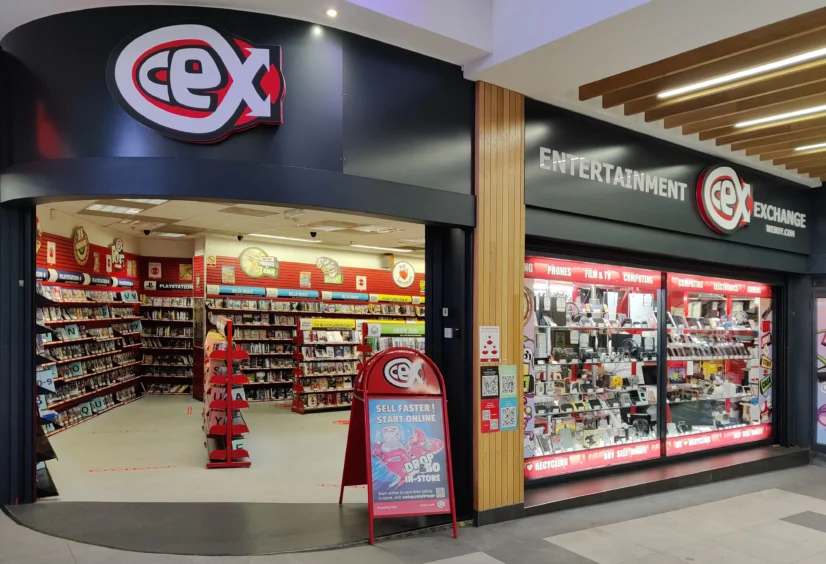
One of the biggest casualties of an all-digital future is the second-hand games market.
Buying a pre-owned game has long been one of the most affordable ways to enjoy gaming. It also allows players to recover some of the cost of new purchases by trading games once they’ve finished them.
Digital licences don’t offer that flexibility.
You can’t sell them, trade them, lend them to a friend or donate them to charity shops. Once purchased, they’re permanently tied to your account under the platform’s licensing terms.
For collectors, families and budget-conscious gamers, that’s a significant change.
Physical media has always represented more than convenience—it has represented ownership, value retention and consumer freedom.
As the industry moves further towards digital-only distribution, those traditional consumer rights are gradually disappearing.
The Competition Question: Is This Healthy for the Games Industry?
The debate surrounding Sony’s decision isn’t simply about plastic discs. At its heart lies a much bigger question: what happens when competition begins to disappear from the way games are sold?
Competition is one of the driving forces behind better prices, improved services and greater consumer choice. When multiple retailers compete to sell the same product, consumers usually benefit through discounts, promotions and innovation.
In the UK, promoting competition is one of the responsibilities of the Competition and Markets Authority (CMA). The regulator exists to encourage competitive markets that work in consumers’ interests, recognising that healthy competition can lead to lower prices, better quality and more choice.
That broader principle is relevant to the gaming industry. While Sony’s digital storefront complies with current market rules, the move towards a future where PlayStation games are only available digitally inevitably raises questions about how much choice consumers will have if there is effectively only one place to purchase those games.
This isn’t about suggesting Sony has broken competition law—it hasn’t been found to have done so. Instead, it’s about asking whether a future with fewer purchasing options ultimately benefits players.
Competition Doesn’t End With Hardware
Console manufacturers have always competed against one another. Sony competes with Microsoft. Microsoft competes with Nintendo. Each wants players to buy into its ecosystem.
But competition shouldn’t stop once you’ve bought the console.
Historically, purchasing a PlayStation game meant choosing between dozens of retailers. High street shops, supermarkets and online stores all fought for customers, often resulting in launch-day discounts that saved players a considerable amount of money.
As physical releases disappear, that layer of competition becomes much smaller.
Instead of retailers competing with each other, pricing becomes increasingly dependent on sales and promotions organised by the platform holder itself.
For consumers, that represents a significant shift in market dynamics.
Could Digital Games Become More Expensive?
No one can say for certain what game pricing will look like in 2028 and beyond. However, economists have long recognised that competition between sellers generally places downward pressure on prices.
When there are fewer competing retailers, that pressure naturally reduces.
Sony regularly runs PlayStation Store sales, and many of them offer genuine value. However, those sales happen according to Sony’s own promotional calendar rather than because rival retailers are trying to undercut one another.
Physical retail created constant competition.
Digital exclusivity creates a different environment, where discounts remain available but are largely controlled from a single source.
Whether this ultimately leads to higher average prices remains to be seen, but it’s one reason many players remain uneasy about an all-digital future.
What About Game Preservation?
Another concern frequently raised by historians, archivists and gaming enthusiasts is preservation.
Video games are part of modern culture. They tell stories, showcase technological innovation and represent decades of creative work.
Physical copies have traditionally provided a level of permanence. Even years after a game leaves store shelves, a disc can often still be played, collected or archived.
Digital-only releases introduce new challenges.
If licensing agreements expire, servers close or storefronts remove titles, future access may depend entirely on decisions made by publishers and platform holders.
Sony, Microsoft and Nintendo have all closed digital storefronts in the past, demonstrating that digital marketplaces are not permanent.
For preservationists, that’s a growing concern as more of gaming history becomes dependent on online infrastructure.
Digital Isn’t the Villain
It’s important to recognise that digital gaming itself isn’t inherently bad.
Millions of players prefer downloading games instead of buying discs.
Digital releases offer convenience that physical media simply can’t match. Games can be preloaded before launch, downloaded instantly without leaving home and accessed without changing discs. Updates are automatic, cloud saves make switching devices easier, and digital libraries allow players to carry hundreds of games without needing physical storage.
For many gamers, that’s a genuinely better experience.
The concern isn’t digital distribution itself—it’s whether digital distribution should also mean fewer choices about where games can be purchased.
Those are two very different discussions.
Sony’s Decision May Be Inevitable—But That Doesn’t Mean It Can’t Be Better
Few people would argue that physical media isn’t declining. Sales data has pointed towards a digital future for years, and publishers naturally follow consumer trends.
From a business perspective, producing fewer discs reduces manufacturing, shipping and retail costs while increasing profit margins on digital sales.
The direction of travel is understandable.
However, understanding why a company makes a decision doesn’t automatically mean consumers have to like the outcome.
If physical games are disappearing, many players believe the next step should be increasing competition within digital marketplaces rather than reducing it.
Allowing authorised third-party retailers to sell digital PlayStation game licences more broadly could preserve many of the benefits consumers currently enjoy through physical competition while still embracing an all-digital future.
Final Thoughts
Sony’s decision to end physical disc production for new PlayStation games from 2028 will be remembered as one of the biggest milestones in the history of console gaming.
For some players, it represents progress—a cleaner, faster and more convenient way to access games.
For others, it represents the loss of something much bigger than a plastic disc.
It represents fewer choices about where games can be bought, fewer opportunities to shop around for better prices, the disappearance of the second-hand market, and a future where ownership increasingly becomes licensing.
Digital gaming is almost certainly the future.
The real question is whether that future should also include genuine marketplace competition.
If physical media is disappearing forever, consumers deserve more choice in the digital world—not less.
If you enjoy games and gaming and want more NEWS from the Gaming World Click Here




You must be logged in to post a comment.