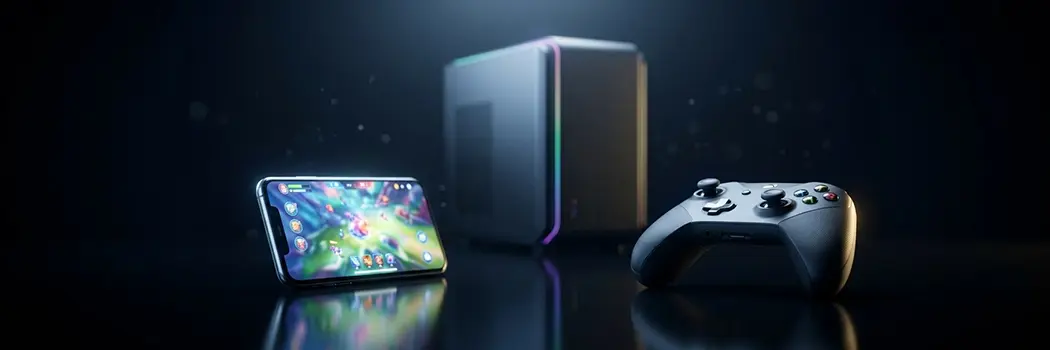
Video games no longer force you to stay tied to a specific PC or console. Play from any device, whenever you want. At the same time, you can chat with friends, and the server automatically saves your progress, so when you log in on another device, your progress carries over with you. How did this become possible? That’s what we’ll explore in this article.
The Technologies That Made Cross-Platform Access Possible
Epic Games developed Unreal Engine, and it’s widely used in games across all platforms: PC, consoles, mobile devices, and VR. It’s even used in creating epic AAA “blockbusters”.
Another thing behind the mobility of online video games is Unity 3D. Developers love it for its ease of use, while gamers are simply glad they can run top titles on iOS and Android, on Windows and Mac, on Nintendo, PlayStation, and Xbox, without running into limitations.
Cloud Gaming Benefits
In the past, you needed quite a lot just to play:
- A powerful console or gaming PC
- At least 100 GB of free storage space for a quality video game
- Stable, unlimited internet to download it (alternative – spending money on a game DVD)
And that’s not even counting joysticks, sound systems, and everything else you needed just to get started. By the time you’d gathered it all, you’d forget why you bothered in the first place.
What Did Cloud Solutions Change?
Xbox Cloud Gaming, Nvidia GeForce Now, and other cloud platforms have emerged. They made it possible to run games on remote servers using, for example, game engines like Unreal Engine 5, so what you see on your screen is essentially streamed video. All the data is processed somewhere outside your device.
Some simple online games run using HTML5. This technology allows you to skip downloading and installing gaming software. The same convenience is offered around free demo slots with 3D effects – their HTML5 versions work with all existing browsers and devices. The user opens the desired slot game and presses “Play” – that’s it, no registration and no bothersome download. It loads in a few seconds and, with a good internet connection, runs without lag.
Speaking of AAA gaming, you cannot run native titles directly in an HTML5 browser. They include high-resolution textures, heavy graphics and audio files, requiring 50GB to 150GB. Web browsers do not load such massive files – they are designed to fetch lightweight assets. What’s more, browsers run inside a “sandbox” to prevent uninhibited access to your computer’s GPU and RAM. This security layer causes significant performance loss compared to native desktop apps. But modern HTML5-based cloud platforms let us stream games such as Call of Duty: Warzone Mobile seamlessly inside browsers like Chrome or Safari.
Play and Save: You Don’t Need a Powerful Device
You don’t need:
- The latest console
- An expensive graphics card (£1,000 to £3,000+), if you have a PC
- A new gaming laptop
In other words, you don’t have to spend your money on powerful, costly hardware, as fewer gadgets will run your favourite game. It can be a smartphone or a budget, low-power PC – and that’s totally enough for most titles. Moreover, some AAA titles can be launched as well as simple titles like Among Us.
Of course, if you dream about a big screen, you can choose something like the Lenovo LOQ 15 or the Acer Nitro V 15. These and similar laptops are cheap and good enough for gaming. Their cost includes decent cooling, 16 GB RAM, preferably 6–8 GB of VRAM, and a GPU starting with an RTX 3050 6 GB. That’s why you’ll be able to pick up some titles from Steam or so and play any game in the cloud.
The Technologies That’ve Let You Save Money
Your savings on hardware wouldn’t be possible if cross-platform solutions weren’t beneficial to developers as well as to gamers. Still, they are cost-effective for companies. For example, they have the open-source Godot Engine, which is used to develop 2D and 3D projects, with an easy-to-use scripting language. We can say the same about the Cocos2D-x framework – it is considered a universal choice among developers.
The Social Aspect: You’re Always in the Loop
Even if you’re holding a smartphone or tablet while your friend has a PS5 Pro, a Nintendo Switch 2, or a PC with a powerful graphics card, you can have a gaming experience similar to theirs. You can just as easily launch Fortnite or Minecraft, and even join multiplayer modes. Chats, competitive play, tournaments, leagues, and more options are the same for every user.
Video game creators have a mission to let you complete your mission and to share impressions with friends. Or to share the same experience. Okay, it’s only a promo promise. The true reason is that it’s very important to keep you engaged, regardless of the hardware you own. So, while you’re saving up for a new PC build or dreaming of a new console, you’re not dropping out of context. You play and discuss the same titles so that you still understand what everyone else is talking about.
Final Thoughts
Countless technologies have gathered into a single field of online video games, so that you can launch them across different devices. On your side are HTML5, cloud gaming, and a bunch of things, allowing you to delve into the toughest challenges in Call of Duty, Overwatch 2 and so on.
Millennials still remember when owning a console meant being king among peers. At the same time, it also meant there were a few people who were kept in the loop and could discuss the latest mission or play together. For today’s gamer, these issues would seem strange, as barriers between device types no longer exist.
The modern landscape has made the gaming community broader, more engaged, and less anxious about buying new hardware. The only downside that is left is the need for a stable, high-speed internet connection. Without it, your next mission is at a stage, as it has to wait for better times. Still, that seems to be the only obstacle – and not a particularly significant one at that.
If you enjoy games and gaming and want more NEWS from the Gaming World Click Here