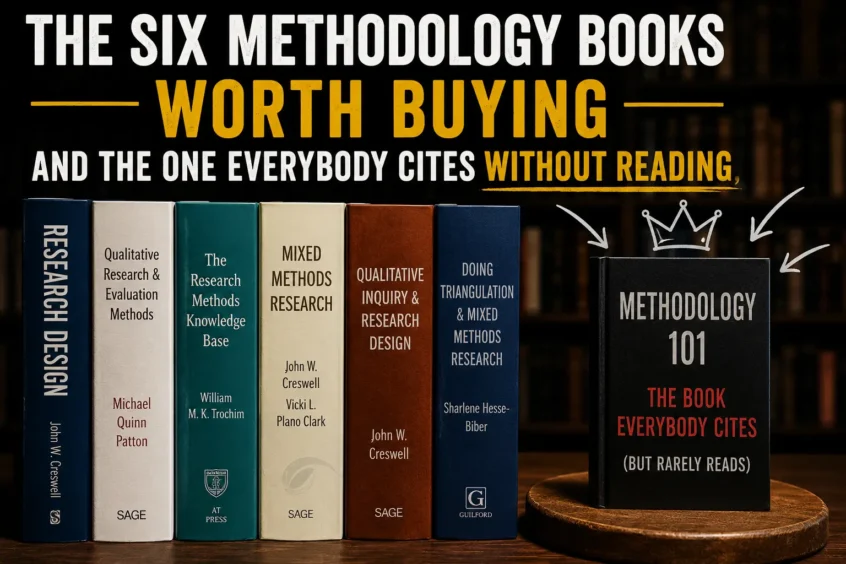
This chapter on dissertation methodology offers practical and usable suggestions. Here are six dissertation methodology books that will provide you with benefits – Creswell to give you the ideas for design decisions, Bryman for complete coverage, Saunders for a step-by-step method for working, Silverman for qualitative depth, Bell for first-time researchers and Robson for practical implementation.
Introduction: Why Most Methodology Reading Lists Are Useless
You are in your final post-graduate year and are staring down a looming methodology deadline. All over the Internet, you find all kinds of lists of dissertation methodology books. They have the same titles repeated again and again without explaining whether they are actually useful. You cannot be sure where they fall short, or if they are worth borrowing versus buying.
This poor guidance has dire consequences, as explained by a study performed in 2025. An extensive review of 139 Master’s theses and doctoral dissertations revealed at least one glaring methodological mistake in 41% of the documents (Debuso et al., 2025).
That is where this guide comes in. We have put together honest, no-nonsense reviews of popular research methods books based on real experience. This guide will tell you which books to purchase and which are a waste of money. You will also discover the books you can quote without reading cover-to-cover.
Key Takeaways for Dissertation Methodology
- Not all research methods books are worth buying; some just need to be checked out from the library.
- The books you need don’t fit into one universal category: you need the right books depending on your dissertation methodology.
- Write honest reviews; it is more valuable to know what doesn’t work in a book than what does.
- No single text is read cover-to-cover by everyone, which is completely fine; scholars frequently reference works they have only partially examined.
- There are virtually no access-restricted titles in the free-shareable category; check the university library first, and save your money.
Choosing vs. Writing: Understanding the Two Types of Books
When searching for dissertation research methods books, it is important to understand that they generally fall into two distinct categories.
The first category helps you select your research approach. These books outline qualitative, quantitative, and mixed-methods frameworks, covering philosophical assumptions and overall research design to guide you in choosing the right methodology for your project.
The second category focuses on writing the methodology chapter itself. These books provide practical advice on structuring the chapter, justifying your methodological choices to examiners, and presenting your research design clearly and defensibly.
Many students mistakenly purchase books from the wrong category for their desired stage. This guide reviews top titles from both types so you can easily decide which one you need.
Books That Help You Choose Your Approach
Research methods books help you choose between qualitative methods, quantitative methods, or a combination of both. They describe the foundational theoretical frameworks of each approach. They help you understand the research design from the beginning. If you still do not know which method you need for your dissertation, start here.
Books That Help You Write Your Methodology Chapter
Dissertation methodology books are designed for those who have already decided on their methodology. They take the time and effort to help you organise your methodology chapter and present your research design clearly and defensibly. Many students mistakenly buy books meant for a different stage of their project. If you have decided on your methodology, then this guide is what you are looking for.
Top 6 Dissertation Methodology Books to Buy
Here comes the part you all have been waiting for. With the six books below, you can find research methods books that will benefit dissertation writing. Each entry includes the full title, author, edition, and publisher information. Each one gives a fair and accurate evaluation of the book’s writing strengths and also includes a candid assessment of areas that still need improvement. Last but not least, each includes a clear recommendation and a definite conclusion on whether it is advisable to buy or borrow it.
This is not the usual roundup of the week at the stores. These are sincere comments about how these books are used in practice. You will discover practical advice that will assist you in making money decisions cost-effectively when purchasing dissertation methodology books.
Book 1: Research Design by Creswell & Creswell (6th Ed)
Authors: John W. Creswell and J. David Creswell
Edition: 6th edition; SAGE; 2022
This dissertation methodology book is a structural blueprint comparing qualitative, quantitative, and mixed-methods approaches side by side. It clearly covers philosophical concepts such as postpositivism, constructivism and pragmatism. This guides you through the entire research proposal process, step by step. Clear, straightforward language ensures this book remains accessible to students throughout their course and serves as a handy reference long after it concludes (Creswell & Creswell, 2022).
Where it falls short: This book is not very practical when it comes to data analysis procedures. Mixed methods coverage feels like an afterthought. There is a lack of discipline-specific examples.
Verdict: Borrow from your institution’s library to establish your structural outline and framework citations, rather than purchasing a new copy.
Book 2: Bryman’s Social Research Methods (7th Ed)
Authors: Tom Clark, Liam Foster, Luke Sloan, Charlotte Brookfield, and Alan Bryman
Edition: 7th edition; Oxford University Press; 2026
This complete textbook on research methods combines theory, practice, and published examples. This text has guided more than any other text over a quarter of a million students in their research. Those qualitative methods are new in the brand-new chapter. In the 7th Edition, you will find the most comprehensive and comparative coverage of quantitative, qualitative, and mixed methods available (Clark et al., 2026)
Where it falls short: At 700+ pages, it is heavy, overwhelming and quite dense for quick answers. It lacks the hyper-tailored focus that business or niche fields might need.
Verdict: An excellent reference work, but best borrowed from a library for targeted citation support unless conducting doctoral-level research.
Book 3: Saunders’ Research Methods for Business Students (9th Ed)
Authors: Mark Saunders, Philip Lewis, Adrian Thornhill
Edition: 9th edition; Pearson; 2025
This book is the leading textbook on business and management dissertation methodology, with more than half a million copies sold worldwide. In practice, the Research Onion model proposed by this book is a highly effective way to structure your thinking. The 9th edition offers practical, step-by-step advice from idea through write-up (Saunders et al., 2025).
Where it falls short: An example that relates to business might not be applicable in other subjects. It is not suitable for other fields such as Sociology, Psychology, or Humanities.
Verdict: Recommended for purchase if completing an applied business project. Non-business students should utilise library copies primarily for the Research Onion framework.
Book 4: Doing Qualitative Research: A Comprehensive Guide by Silverman and Marvasti (6th Ed)
Author: David Silverman and Amir Marvasti
Edition: 6th edition; SAGE; 2022
This is a complete Qualitative Researcher’s guide. It provides practical tips for defining what is original and for narrowing and concentrating your topic. The use of student diaries and real-life examples makes it relevant. This book pulls back the curtain on how qualitative research actually happens in practice. It tackles the stressful, practical questions textbooks usually ignore—such as “How many interviews do I actually need?” or “What do I do when my transcript data feels completely messy?” This insight is valuable, with guidance from experts in qualitative data analysis software (Silverman & Marvasti, 2022).
Where it falls short: No value for quantitative research. This is not just any book on dissertation methodology. It is a PhD exam section that is aimed at the UK context.
Verdict: Access via your library or institutional e-book platform. Review the relevant sections on interview design and qualitative validation without purchasing a personal copy.
Book 5: Bell and Waters’ Doing Your Research Project: A guide for first-time researchers (7th Ed)
Authors: Judith Bell and Stephen Waters
Edition: 7th edition; Open University Press; 2018
Written specifically for early-stage researchers, this book assumes no prior background knowledge. It provides a practical, down-to-earth overview of the entire research project lifecycle from conception to completion. Its clear, accessible style makes it ideally suited for undergraduate and taught Master’s students undertaking their first major research assignment (Bell & Waters, 2018).
Where it falls short: It lacks the theoretical depth required for advanced or doctoral-level research and is unlikely to serve as a long-term reference text.
Verdict: Worth purchasing for undergraduate or taught Master’s programs, but doctoral students should borrow it instead, as advanced research requires greater methodological rigour.
Book 6: Real World Research by Robson and McCartan (5th Ed)
Author: Colin Robson and Kieran McCartan
Edition: 5th edition; Wiley; 2024
This book bridges the gap between academic theory and real-world practice. It excels in addressing practical research challenges, such as securing access, managing ethics, and handling project timelines, making it particularly strong for applied and mixed-methods research in professional settings (Robson & McCartan, 2024).
Where it falls short: It offers less theoretical depth than Creswell or Bryman, making it less helpful for justifying purely academic methodological choices. Coverage of digital research methods can also feel somewhat dated.
Verdict: Buy it if you are conducting practical or practice-based research; borrow it if you only need brief theoretical justifications for a traditional academic thesis.
The Most Overrated Methodology Book (Skip It)
There is always one kind of dissertation methodology book found in every bibliography. However, few students read it from beginning to end. It is typically Cohen, Manion, and Morrison’s Research Methods in Education, which is referenced widely in virtually every educational study. The 8th edition was released in the year 2018.
What is causing this to happen? Supervisors recommend it. Inclusion in all reference lists seems to be a standard requirement. However, the text is dense and dated, and there is a strong emphasis on educational aspects. You don’t need to read and understand it cover-to-cover.
Let’s get started with what you are going to do. Read the required chapter corresponding to the method you used. Cite it appropriately. Move on. Resources that help you in your dissertation research should be your research methods books for the dissertation, not academic badges of honour.
Qualitative vs Quantitative: Where the Recommendations Diverge
Use the research methodology dictated by the type of research you will conduct; this will determine which dissertation methodology books you need. To get a quick reference, see the following guide:
| Your Approach | Best Books | Books to Avoid |
| Qualitative | Silverman, Bryman, Creswell | Saunders (too business-focused), Robson (if you need theoretical depth) |
| Quantitative | Bryman, Creswell, Robson | Silverman (qualitative only) |
| Mixed Methods | Creswell (best), Bryman, Robson | Silverman (does not cover quantitative) |
| Business/Management | Saunders (best), Bryman, Robson | Silverman (unless doing qualitative business research) |
| First-time Researcher | Bell & Waters, Robson | Bryman (too comprehensive), Creswell (if you have not chosen an approach yet) |
Some research methods books are useful, and some are not, depending on your discipline and methodology. Please do not buy a book just because it is popular. Buy it because it suits your needs.
Comparison Table: Choosing Your Methods Book
This is a comprehensive comparison of all six of the dissertation methodology books. The purpose of this table is to determine at a glance which book is applicable for your situation.
| Book | Best For | Weak On | Verdict | Cheapest Access |
| Creswell Research Design | Choosing approach; philosophical justification | Data analysis techniques | Buy if undecided, not a brand-new copy | Library; used copies ~£25 |
| Bryman Social Research Methods (2026) | Comprehensive reference | Quick answers; overwhelming | Don’t buy unless PhD | Library; £54.99 new |
| Saunders Research Methods for Business Students (2025) | Step-by-step process; business context | Non-business disciplines | Buy if business student | Library; £66.99 new |
| Silverman Doing Qualitative Research | Qualitative methodology | Quantitative methods | Buy if qualitative | Library; e-book access |
| Bell & Waters Doing Your Research Project | First-time researchers | Depth; doctoral level | Buy for first project | Library; affordable new |
| Robson Real World Research (2025) | Applied/practice-based research | Theoretical depth | Buy if applied | Library; used copies |
Free and Library Routes Worth Using Before Buying
If you need to write your dissertation, don’t buy a book version; look for free access options first. Most titles are available in the university library, either in print or as electronic books. SAGE Research Methods provides web resources. Alternatively, older editions will do; methodology does not change quickly. For extra guidance, you can find helpful advice on the Affordable Dissertation UK website.
For those needing personalised support, many students consult with expert dissertation writers who specialise in helping you decide on your research framework and structuring your methodology chapter. If you are exploring professional assistance, specialised dissertation writing services can be invaluable. For the best support for students, The Academic Papers UK is also frequently recommended for its comprehensive academic resources.
Final Verdict: How to Choose Your Methodology Book
No single dissertation methodology book does it all. The best research methods book depends on your stage, research discipline, and methodology.
Purchase the one that fits your requirements. Borrow the others. Remember to mention the famous one without repeating it.
There is no “right” or “wrong” way to write the methodology section. It must be able to defend itself. The following six dissertation methodology books will help you along the way.
Frequently Asked Questions
Which methodology book is best for a beginner?
Doing Your Research Project by Bell and Waters is the best book for beginner students conducting research projects. It is totally self-contained, requires no background reading, and covers all aspects of the project from start to finish. If you are debating which method to use to approach the question, Creswell is good, too.
Do I need to buy the latest edition of a methodology book?
Not necessarily. Methods do not evolve very quickly. The principles of research methodology have not changed. When you buy the latest edition, you are only doing so to test if it includes current examples or references.
Can I cite a methodology book I have not fully read?
Yes, but only if you have read the specific chapter you are referring to. Avoid using the whole book as a source. Give attention to the portion that has developed your argument. This is actually normal and is acceptable.
What’s the difference between a methods book and a methodology book?
Methodology includes the philosophy of research and general approach to the research. Methods are the particular methods you employ. Both are needed in any dissertation methodology, though their significance may differ when choosing research methods books for a dissertation.
Should I buy or borrow methodology books?
Buy the one that matches your basic philosophy. Use the other part of your research from the University library. Most students need only one or two, intended as permanent references for dissertation research methods.